


A premarital agreement in North Carolina is a written contract two people sign before marrying that sets how property, income, and spousal support will be handled if the marriage ends by separation, divorce, or death.
Under N.C.G.S. Chapter 52B, the agreement must be in writing, signed by both parties, and take effect at marriage.
A premarital agreement attorney helps a couple identify what each owns and owes, exchange financial information, and shape terms that replace default equitable distribution rules without crossing the statute’s limits.
A productive first meeting starts with a list of assets, debts, and retirement accounts. A consultation with Larry Hudspeth can cover them, so schedule one.
A North Carolina premarital agreement is enforceable when it meets Chapter 52B’s formal requirements and the spouse resisting it cannot prove a statutory defense.
Formal requirements, litigation defenses, and practical precautions are three different things, and confusing them is the most common misunderstanding about these agreements.
Financial disclosure is not a formal execution requirement under § 52B-3, so an agreement signed without it is not automatically invalid.
Disclosure still carries real weight: it lets each party make an informed decision, shapes negotiation of the terms, and becomes central evidence if the unconscionability defense described below is ever raised.
N.C.G.S. § 52B-7 gives a spouse resisting enforcement two separate routes. The first is proof that the spouse did not sign voluntarily.
The second requires proof of four elements together: the agreement was unconscionable when signed, and before signing that spouse (1) did not receive fair and reasonable disclosure of the other’s property and financial obligations, (2) did not voluntarily waive further disclosure in writing, and (3) did not have, and could not reasonably have had, adequate knowledge of those finances.
Unconscionability, meaning terms so one-sided that a court will not enforce them, is a legal question the judge decides.
A separate safeguard applies to spousal support. Section 52B-7(b) lets a court require support despite a waiver to the extent needed to keep a dependent spouse from becoming eligible for public assistance at separation or divorce.
| Statutory Defense | Practical Precaution That Builds a Stronger Record |
| Involuntary signing | Allowing time between the final draft and the wedding, with each party free to consult a separate attorney |
| Unconscionability plus nondisclosure | Attaching financial schedules or obtaining a written, informed waiver of further disclosure |
| Public assistance override | Testing support terms against each party’s realistic future income |
These precautions are prudent practice, not statutory requirements, and none guarantees that a court will enforce a particular agreement.
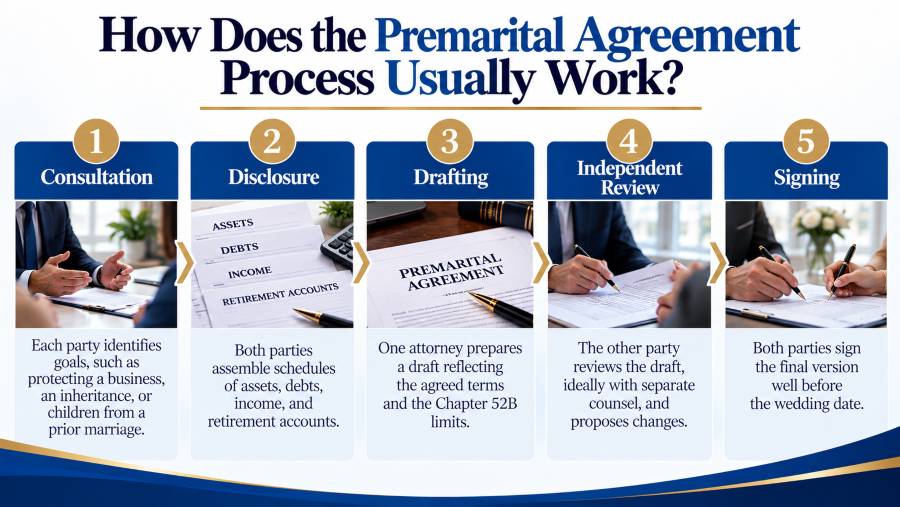
The premarital agreement process usually moves through five stages, and starting early gives each stage room to work. The exact workflow for any engagement is set during the initial consultation.
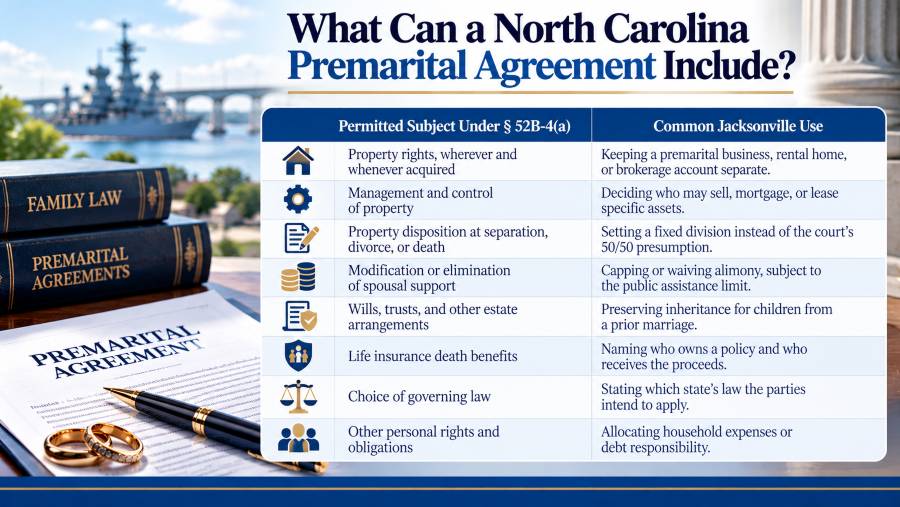
A premarital agreement can cover nearly any financial matter between future spouses, as long as the term doesn’t violate public policy or a criminal statute. N.C.G.S. § 52B-4 lists permitted subjects, and Jacksonville couples often use the agreement to protect a business, an inheritance, or children from a prior marriage.
| Permitted Subject Under § 52B-4(a) | Common Jacksonville Use |
| Property rights, wherever and whenever acquired | Keeping a premarital business, rental home, or brokerage account separate |
| Management and control of property | Deciding who may sell, mortgage, or lease specific assets |
| Property disposition at separation, divorce, or death | Setting a fixed division instead of the court’s 50/50 presumption |
| Modification or elimination of spousal support | Capping or waiving alimony, subject to the public assistance limit |
| Wills, trusts, and other estate arrangements | Preserving inheritance for children from a prior marriage |
| Life insurance death benefits | Naming who owns a policy and who receives the proceeds |
| Choice of governing law | Stating which state’s law the parties intend to apply |
| Other personal rights and obligations | Allocating household expenses or debt responsibility |
Estate planning terms work best when the documents match. A premarital agreement that preserves an inheritance for adult children should be reviewed alongside the spouse’s will, any trust, and the beneficiary designations on retirement accounts and life insurance, because a beneficiary form left unchanged can direct money in ways the agreement did not contemplate.
How the agreement interacts with a surviving spouse’s rights under North Carolina law is a question to review with estate planning counsel.
Three limits restrict what a North Carolina premarital agreement can accomplish. The first is absolute; the other two depend on facts at signing or at divorce.
Child custody also falls outside the agreement’s practical reach, because a court decides custody based on the child’s best interest at the time of the dispute.
Couples with children from earlier marriages need to address these limits. A consultation with Larry Hudspeth can test terms against Chapter 52B, so request a review.
Military couples near Camp Lejeune and MCAS New River face a split between state and federal rules that civilian couples never encounter.
North Carolina law and the agreement determine how much retired pay each spouse is entitled to; federal law determines whether and how the Defense Finance and Accounting Service pays it.
Consider a hypothetical. A Marine with six years of service marries a spouse who owns a small Jacksonville business. Their agreement keeps the business separate and gives the spouse a fixed share of retired pay earned during the marriage.
If they divorce after eight years of overlapping service, the spouse’s claim to that share depends on the agreement surviving any § 52B-7 challenge, on federal limits such as the disability rule in Howell, and on a divorce order that incorporates the term.
Even with all three in place, the shorter overlap means DFAS will not pay that share directly, so the agreement and order should specify how payment is made and how it would be enforced, details to confirm with counsel when the order is drafted.
Choice-of-law clauses deserve realistic expectations. Section 52B-4(a)(7) lets a couple state that North Carolina law governs the agreement, but a court in another state where the couple later lives will apply its own rules in deciding whether to honor that clause.
Couples facing frequent moves benefit from terms that would hold up under more than one state’s law, a planning concern that also shapes how military divorce cases unfold.
A premarital agreement can be amended or revoked after marriage only by a new written agreement signed by both spouses. N.C.G.S. § 52B-6 makes that amendment enforceable without consideration, so neither spouse must give anything new in exchange.
Common reasons to revisit an agreement include the birth of a child, a business sale, an inheritance, or a military retirement.
Reviewing the agreement after any major financial change confirms whether the original terms still reflect the couple’s intent, and an amendment signed with updated financial schedules is easier to defend than a decade-old document applied to very different facts.
Spouses who disagree about an amendment’s meaning often resolve it through family financial mediation rather than a hearing.
Section 52B-9 pauses statutes of limitations on claims under the agreement during the marriage.
Laches, which bars claims a party unreasonably delayed, and estoppel, which bars a party from contradicting earlier conduct another relied on, remain available, so a spouse who sits on a known claim may still face difficulty enforcing it.
A valid premarital agreement replaces the default rules for the issues it covers, and issues it does not address, along with child support and custody, follow ordinary North Carolina law.
In a divorce, the spouse relying on the agreement presents it, and the spouse resisting it must prove a § 52B-7 defense.
Interpretation disputes, such as whether a later-acquired asset falls inside a separate-property clause, are common and often settle before trial.
A premarital agreement attorney identifies each party’s goals, organizes financial disclosure, drafts or reviews terms against Chapter 52B limits, and explains what each waiver gives up. Military couples also need retired pay terms written to work with later DFAS court orders.
No. N.C.G.S. § 52B-3 requires only a writing signed by both parties. Some couples choose notarized signatures to document execution, but notarization is a practical choice rather than a statutory requirement and does not by itself decide whether a court enforces the agreement.
Yes. Section 52B-4(a)(4) allows future spouses to modify or eliminate spousal support. A North Carolina court can still require support despite the waiver if enforcing it would leave a dependent spouse eligible for public assistance at the time of separation or divorce.
No. Section 52B-4(b) bars any term that harms a child’s right to support, and custody depends on the child’s best interest when the court rules. Future parents can address property and spousal support in the agreement, but not their children’s support.
North Carolina law does not require separate counsel. Independent advice can help show that each party understood the terms and signed voluntarily, which may matter if the agreement is later challenged, though no single precaution guarantees enforcement in every case.
North Carolina sets no minimum waiting period between signing and the wedding. Signing shortly before the ceremony can support a claim of pressure, so allowing time between the final draft and the wedding is prudent practice, not a statutory rule.
Yes. Section 52B-4(a)(3) lets the couple set how retired pay earned during the marriage is treated. DFAS acts only on a qualifying court order, and pays a former spouse directly only after a 10-year overlap, so the agreement and later order must align.
Not automatically. Section 52B-4(a)(7) lets couples state which law governs, but a court in the state where the dispute arises applies its own rules in deciding whether to honor that choice. Couples who relocate often should review the agreement with local counsel.
A premarital agreement works best when it is treated as a planning project rather than a pre-wedding formality.
Couples who start early, exchange complete financial information, coordinate estate documents, and, for military families, align retired pay terms with federal payment rules give the agreement its strongest chance of being enforced as written.
A consultation with Larry Hudspeth can cover each party’s goals, the assets to schedule, and any military pension questions. Schedule a premarital agreement consultation.
Office

Links