


North Carolina calculates child support through the Child Support Guidelines, which apply as a rebuttable presumption in every proceeding and produce a presumptive figure from both parents’ adjusted gross incomes, the number of children, and the overnight schedule.
A judge may depart from that figure, but only on evidence and written findings. Which of the three worksheets applies turns on the custody arrangement, measured in nights.
Worksheet inputs decide the number long before a hearing does. Hudspeth Family Law reviews the calculation before it reaches a judge — schedule a consultation.
North Carolina uses the income shares model, which assumes a child should receive the same proportion of parental income the child would have received had the parents lived together.
The North Carolina Child Support Guidelines, prescribed by the Conference of Chief District Judges under N.C. Gen. Stat. § 50-13.4 and effective January 1, 2023, control the calculation.
The sequence runs the same way in every case:
The Guidelines govern consent orders and voluntary support agreements approved by the court, not only contested hearings. They do not apply to stepparents or others who are only secondarily liable.
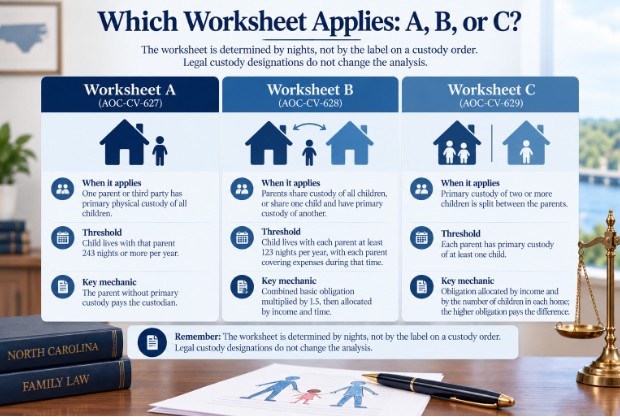
The worksheet is determined by nights, not by the label on a custody order. Legal custody designations do not change the analysis.
| Worksheet | When it applies | Threshold | Key mechanic |
| A (AOC-CV-627) | One parent or third party has primary physical custody of all children | Child lives with that parent 243 nights or more per year | The parent without primary custody pays the custodian |
| B (AOC-CV-628) | Parents share custody of all children, or share one child and have primary custody of another | Child lives with each parent at least 123 nights per year, with each parent covering expenses during that time | Combined basic obligation multiplied by 1.5, then allocated by income and time |
| C (AOC-CV-629) | Primary custody of two or more children is split between the parents | Each parent has primary custody of at least one child | Obligation allocated by income and by the number of children in each home; the higher obligation pays the difference |
Two provisions are easy to misapply. A parent whose visitation falls below the 123-night threshold does not have shared custody regardless of how the order is captioned, so Worksheet B does not apply.
And where the parents share custody of one child while one parent has primary custody of another, the Guidelines direct the whole case to Worksheet B rather than a mix of A and B. The overnight count therefore carries the same weight as the income figures.
Income means actual gross income from any source, before deductions. The Guidelines cast that net wide and define the exclusions narrowly, which is why income is the most contested input on most worksheets.
The definition reaches wages, commissions, bonuses, severance, self-employment and business income, rental income, dividends, interest, trusts, annuities, capital gains, pensions, Social Security, workers’ compensation, unemployment benefits, disability pay, gifts, prizes, and alimony received from a third party. Irregular or one-time income may be averaged over a period the court sets.
In-kind payments and expense reimbursements received through employment count as income when they are significant and reduce personal living expenses, and the Guidelines list free housing as an example.
No separate military pay rule exists, so each component is measured against that general definition rather than a service-specific schedule.
Veterans Administration and Social Security benefits paid for a child because of a parent’s disability or retirement are attributed to that parent as income, then deducted from that parent’s obligation if the other parent receives them.
Means-tested benefits including TANF and SSI fall outside the definition entirely, as does child support received for a different child.
Current earnings require at least one full month of pay stubs, an employer statement, or business receipts, plus the most recent tax return to verify a longer period. Sanctions are available against a party who fails to comply.
Imputation requires a finding of bad faith — voluntary unemployment or underemployment reflecting deliberate suppression of income. It is unavailable against a parent who is physically or mentally incapacitated, and 45 C.F.R. § 302.56(c)(3) bars treating incarceration as voluntary unemployment.
Where imputation applies, and the parent has no recent work history, potential income starts at minimum wage for a 35-hour week.
Income disputes drive many contested support cases. Larry Hudspeth documents earnings and imputation issues for Onslow County parents — request support representation.
The schedule figure is not the final number. Three categories of cost are added and prorated between the parents by income share.
| Addition | What qualifies | Limits worth knowing |
| Work-related child care | Costs paid or to be paid because of employment or job search | Child care during school attendance is a deviation issue, not an automatic addition |
| Health insurance premium | The portion of the premium attributable to the covered children | Employer-paid amounts not deducted from wages are excluded; coverage is reasonable under § 50-13.11(a1) if it costs no more than 5 percent of the parent’s gross income |
| Extraordinary expenses | Special or private schooling for the child’s particular needs, and transportation between the parents’ homes | Added only where the court finds them reasonable, necessary, and in the child’s best interest |
Uninsured medical costs sit differently. The basic obligation already includes $250 per child per year for uninsured medical and dental expenses.
Costs above that line — including orthodontia, vision care, physical therapy, chronic condition treatment, and counseling for a diagnosed disorder — may be ordered paid by either parent or split in whatever proportion the court finds appropriate.
Four situations move a case off the standard worksheet path, and each is where judicial judgment enters.
Low income. The Guidelines build in a self-support reserve of $1,133 per month, based on the 2022 federal poverty level for one person. An obligor with adjusted gross income under $1,150 receives a minimum order of $50 absent deviation.
Where the obligor’s income falls in the shaded area of the schedule, and Worksheet A applies, the obligation is computed on the obligor’s income alone, and child care and health insurance premiums are left out of the calculation.
High income. Above $40,000 in combined adjusted gross monthly income, or $480,000 per year, the schedule stops. The court then sets support to meet the child’s reasonable needs for health, education, and maintenance, weighing the estates, earnings, conditions, and accustomed standard of living of the child and the parties, along with each party’s child care and homemaker contributions.
Deviation. Either party or the court may seek deviation. Granting it requires evidence and four written findings: the presumptive Guidelines amount, the child’s reasonable needs and each parent’s relative ability to pay, why the presumptive amount is inadequate or excessive, and the basis for the amount actually ordered. Paying support for two or more families under separate orders is one recognized ground.
An existing separation agreement. Where the parents executed a valid unincorporated separation agreement fixing child support, a later court action must base the obligation on the agreement rather than the Guidelines, unless the evidence shows by the greater weight that the agreed amount is unreasonable given the child’s needs.
The same rule governs retroactive support for the period the agreement covered. Whether an agreement was incorporated into a decree is therefore the first question in any enforcement or modification review.
Modification requires a substantial change in circumstances. The Guidelines supply a presumption: where the order was entered at least three years before the motion was filed, a difference of 15 percent or more between the existing order and a fresh Guidelines calculation is presumed to be a substantial change.
Federal rule adds a second route, since the need to provide for a child’s health care needs is itself a substantial change whether or not the support figure moves.
Support ordinarily runs until the child turns 18, or until graduation if the child is still enrolled in secondary school, and cannot extend past the twentieth birthday under § 50-13.4(c). Emancipation ends it earlier.
The NC Judicial Branch child support help topic sets out the filing routes available to a parent or caretaker. Arrears survive termination of the ongoing obligation, and payments on arrears are not deducted from gross income in a new calculation.
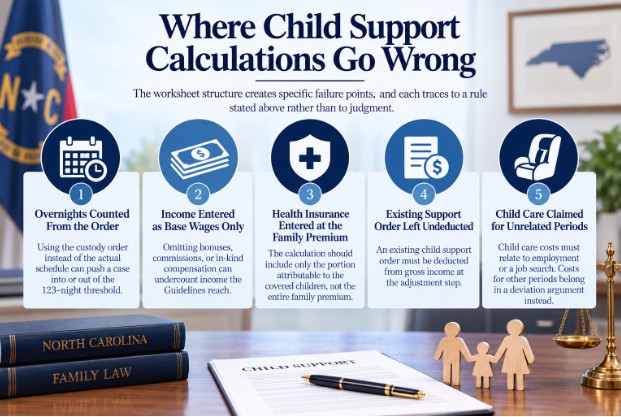
The worksheet structure creates specific failure points, and each traces to a rule stated above rather than to judgment:
Preparing to challenge or defend a figure means assembling the documentation the Guidelines require: at least one full month of pay records, the most recent tax return, health insurance statements showing the child-only cost, child care invoices tied to work hours, and any existing support orders.
Hudspeth prepares the worksheet, verifies income against documentation, and identifies whether deviation or a shaded-area adjustment applies before a figure is presented to the court.
The firm handles matters involving divorce, alimony, or equitable distribution alongside support, since income findings in one claim affect the others.
Parents who prefer to resolve support outside a hearing can use family financial mediation, and contested matters proceed through litigation if they do not reach an agreement.
The firm’s material on setting child support and the sources of income the Guidelines cover provides additional background.
How is child support calculated in North Carolina? North Carolina uses an income shares model. The court combines both parents’ adjusted gross monthly incomes, reads the basic obligation from the Schedule of Basic Support Obligations, adds qualifying costs, then divides the total between the parents in proportion to income.
Which worksheet applies to shared custody? Worksheet B applies when a child lives with each parent at least 123 nights a year, and each parent covers expenses during that time. Shared custody raises the combined basic obligation by 50 percent before allocation between the parents under the Guidelines.
Does a housing allowance count as income for child support? The Guidelines define income as actual gross income from any source and count in-kind payments, such as free housing, when they are significant and reduce personal living expenses. In most cases, in-kind housing falls under that definition.
What is the minimum child support order in North Carolina? Fifty dollars per month. The Guidelines set that minimum for obligors whose adjusted gross income falls below $1,150 a month, absent a deviation, and build a self-support reserve of $1,133 into the schedule for incomes above that line.
What happens when parents earn more than the schedule covers? The schedule stops at $40,000 combined adjusted gross monthly income, or $480,000 a year. Above that figure, the court sets support to meet the child’s reasonable needs for health, education, and maintenance, weighing the family’s accustomed standard of living and other case facts.
Can a judge order an amount different from the worksheet? Yes, through deviation. The court must hear evidence on the child’s reasonable needs and each parent’s ability to pay, then make written findings stating the presumptive amount, why it is inadequate or excessive, and the basis for the amount ordered.
When can an existing child support order be modified? A difference of 15 percent or more between the current order and a new Guidelines calculation is presumed to be a substantial change when the order was entered at least three years before the motion to modify was filed with the court.
Does income get imputed to a parent who quits a job? Only on a bad-faith finding. The court must conclude that voluntary unemployment or underemployment reflects deliberate income suppression. Imputation is barred for a parent who is physically or mentally incapacitated, and incarceration cannot be treated as voluntary unemployment under federal rule.
Do the Guidelines apply when parents already signed a separation agreement? Not automatically. Where an unincorporated separation agreement sets child support, the court bases the obligation on the agreement rather than the Guidelines, unless the evidence shows that the agreed amount is unreasonable given the child’s needs and the statutory factors.
When does child support end in North Carolina? Child support runs until the child turns 18, or until graduation from high school if the child is still enrolled, and cannot extend past the twentieth birthday. Emancipation before 18 also ends the obligation earlier under North Carolina law.
A support order entered today can shape a household budget for years. Larry Hudspeth brings 45 years of family law experience — start a conversation.
Office

Links