


North Carolina divides marital and divisible property through equitable distribution, not a strict 50/50 split, whenever divorcing spouses cannot agree on their own settlement before the case reaches a judge.
Courts start with a presumption of equal division under N.C. Gen. Stat. § 50-20, but either spouse can argue for an unequal division by weighing the statute’s twelve statutory factors.
North Carolina is not a community property state like Texas or California — “equitable” means fair, not automatically equal, and mediation is required before most contested cases reach a hearing.
Confused about what counts as marital property? Schedule a consultation with N. Lawrence “Larry” Hudspeth III before your first mediation session.
Equitable distribution is the legal process North Carolina courts use to divide marital and divisible property fairly between divorcing spouses, under N.C. Gen. Stat. § 50-20.
The court starts with a presumption that an equal division by net value is equitable, but either spouse can rebut that presumption by showing the statutory factors favor an unequal split.
North Carolina is not a community property state, unlike Texas or California, where marital assets are automatically split 50/50 regardless of circumstances. “Equitable” means fair — and fair sometimes means one spouse receives more than half the marital estate.
Property classification determines what a court can actually divide, so it comes before any factor analysis. Marital property includes nearly everything either spouse acquired during the marriage and before the date of separation, regardless of whose name appears on the title — including pension, retirement, and deferred compensation rights earned during the marriage.
Separate property remains with the spouse who owns it and is not divided, including property acquired before the marriage and most gifts or inheritances received individually.
Divisible property covers passive changes in the value of marital property — such as interest, dividends, or appreciation — that occur after separation but before the court finalizes the distribution.
A judge weighs twelve statutory factors under N.C. Gen. Stat. § 50-20(c) to decide whether an equal division would actually be unfair given the specific circumstances of the marriage.
| Statutory Factor | What the Court Considers |
| Income, property, and liabilities | Each spouse’s financial position at the time of division |
| Prior marriage support obligations | Any existing duty to support a former spouse |
| Duration and health of the marriage | Length of marriage plus age, physical, and mental health of both spouses |
| Custodial parent’s housing need | Whether a parent needs to retain the marital residence for the children |
| Separate pension expectations | Retirement rights that are not marital property |
| Contributions to the marriage | Direct and indirect contributions, including homemaking and child-rearing |
| Contributions to a spouse’s earning power | Support that helped the other spouse gain education or career advancement |
| Liquidity of assets | Whether property can be readily converted to cash without loss of value |
| Difficulty valuing a business interest | Complexity in appraising a closely held business or professional practice |
| Tax consequences | Federal and state tax impact of the division on each spouse |
| Waste or preservation of property | Whether either spouse maintained, wasted, or converted marital assets after separation |
| Any other just and proper factor | Catch-all allowing the court to weigh circumstances not otherwise listed |
Military retirement pay counts as marital property under the Uniformed Services Former Spouses’ Protection Act, regardless of how long the marriage lasted, so long as the pension accrued during the marriage.
The court divides only the portion of retired pay that accrued between the marriage date and the date of separation, using a marital fraction tied to the servicemember’s rank and years of service at that time.
The “10/10 rule” governs how the former spouse gets paid, not whether the pension can be divided at all.
Direct payment from the Defense Finance and Accounting Service to a former spouse is only available when the marriage overlapped with at least 10 years of the service member’s creditable military service — this is the well-known “10/10 rule.
” If that overlap threshold isn’t met, DFAS won’t administer the payments, and the servicemember becomes personally responsible for paying their former spouse’s awarded share directly.
Given Onslow County’s proximity to Camp Lejeune and MCAS New River, the pension division under USFSPA comes up in a substantial share of the equitable distribution cases handled in the Fourth Judicial District.
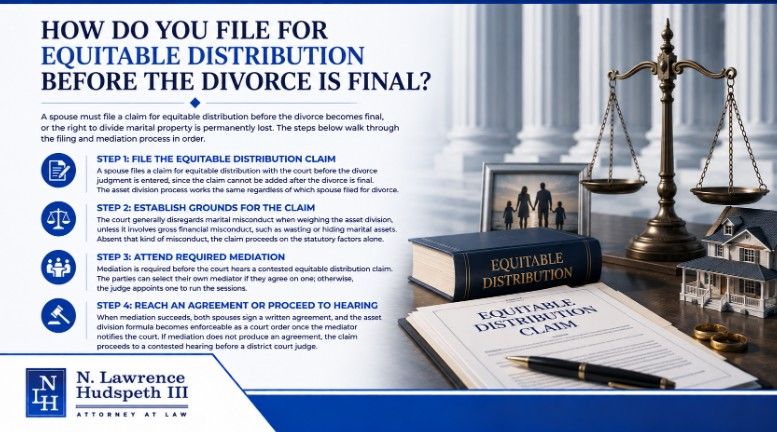
A spouse must file a claim for equitable distribution before the divorce becomes final, or the right to divide marital property is permanently lost. The steps below walk through the filing and mediation process in order.
A spouse files a claim for equitable distribution with the court before the divorce judgment is entered, since the claim cannot be added after the divorce is final. The asset division process works the same regardless of which spouse filed for divorce.
The court generally disregards marital misconduct when weighing the asset division, unless it involves gross financial misconduct, such as wasting or hiding marital assets. Absent that kind of misconduct, the claim proceeds on the statutory factors alone.
Mediation is required before the court hears a contested equitable distribution claim. The parties can select their own mediator if they agree on one; otherwise, the judge appoints one to run the sessions.
When mediation succeeds, both spouses sign a written agreement, and the asset division formula becomes enforceable as a court order once the mediator notifies the court. If mediation does not produce an agreement, the claim proceeds to a contested hearing before a district court judge.
An equitable distribution affidavit is the financial disclosure document that each spouse typically brings to mediation or a hearing, prepared with help from a Family Financial Mediator, who ensures both parties disclose their finances fairly and transparently.
The affidavit lists marital property acquired during the marriage, separate property each spouse claims individually, property attributed to the other spouse, and all debts either spouse incurred during the marriage.
Getting this affidavit right the first time matters, so you can avoid the delays and added costs that come from incomplete or contested financial disclosures later in the case.
Facing an equitable distribution claim involving a business, military pension, or contested asset is harder to sort out alone — reach out for a confidential consultation with Hudspeth to build an affidavit and a negotiating position based on the factors that actually apply to your case.
Is North Carolina a community property state?
No. North Carolina is an equitable distribution state under N.C. Gen. Stat. § 50-20. Courts start with a presumption of equal division but can order an unequal split based on the twelve statutory factors listed in the statute.
What counts as marital property in North Carolina?
Marital property includes nearly everything either spouse acquired during the marriage and before separation, regardless of whose name is on the title. This includes vested and nonvested pension, retirement, and deferred compensation rights earned during the marriage.
Is military retirement pay divided in a North Carolina divorce?
Yes. Military retirement pay earned during the marriage counts as marital property under the Uniformed Services Former Spouses’ Protection Act, regardless of the length of the marriage, and is subject to equitable distribution like any other asset.
What is the 10/10 rule for military pension division?
The 10/10 rule determines how a former spouse gets paid, not whether the pension can be divided. If the marriage overlapped with at least 10 years of military service, DFAS pays the former spouse’s share directly rather than to the service member.
Does the court always split marital property 50/50?
No. North Carolina starts with a presumption of equal division, but a judge can order an unequal split if the statutory factors under N.C. Gen. Stat. § 50-20(c) shows that an equal division would not be fair to one spouse.
Is mediation required before an equitable distribution hearing?
Yes. Mediation is required before the court hears a contested equitable distribution claim. Parties can choose their own mediator, or the judge appoints one if the parties cannot agree.
Does marital misconduct affect equitable distribution?
Generally no. Marital misconduct has little bearing on asset division unless it involves gross financial misconduct, such as one spouse wasting, hiding, or converting marital property after separation.
What happens if I don’t file for equitable distribution before the divorce is final?
The right to divide marital property is permanently lost if a claim is not filed before the judgment of divorce is entered. This makes timing the claim correctly one of the most critical steps in the process.
What is an equitable distribution affidavit?
An equitable distribution affidavit is a financial disclosure document listing marital property, separate property, property attributed to each spouse, and all marital debts. Both parties typically prepare one before mediation or a court hearing.
What is the difference between marital and divisible property?
Marital property is acquired during the marriage and before separation. Divisible property covers passive post-separation changes in value, such as interest, dividends, or appreciation, that occur before the court finalizes the distribution.
Don’t let a military pension or contested asset slip through the cracks — call Hudspeth before mediation begins to protect what’s yours.
Office

Links