


A North Carolina divorce takes a minimum of 1 year, with 30 to 90 days from separation to final decree. North Carolina law requires spouses to live separate and apart for a full year before either party can file for absolute divorce, under N.C. Gen. Stat. § 50-6.
Once the separation period ends and a complaint is filed, an uncontested case typically concludes within 30 to 90 days, while a contested case can take 6 months or more.
Waiting a full year to file is the hardest part of divorce for most Jacksonville families — Larry Hudspeth helps clients use that separation period productively, from drafting a separation agreement to preparing custody and support terms before the case ever reaches a judge.
North Carolina’s one-year separation rule is a legal mandate requiring spouses to live in separate residences, with at least one spouse intending the separation to be permanent, for 365 consecutive days before either party can file for absolute divorce.
This requirement is set out in N.C. Gen. Stat. § 50-6, the statute governing divorce after separation. Sleeping in separate bedrooms within the same house does not satisfy this requirement — the spouses must maintain genuinely separate residences.
If the couple resumes living together at any point during the year, even briefly, the separation clock restarts from that date, so you can lose months of progress from a single lapse.
At least one spouse must also have resided in North Carolina for six months immediately before filing, as required under N.C. Gen. Stat. § 50-8.
If you’re ready to get started, call us now!
An uncontested North Carolina divorce, once filed, is typically finalized in 30 to 90 days. After the complaint is served, the responding spouse has 30 days to answer or waive that right.
Once that window closes, the filing spouse can request a hearing date, which most district courts schedule within six to eight weeks, depending on docket volume.
The hearing itself is brief — most uncontested divorce hearings in North Carolina last only 5 to 15 minutes, since the judge is confirming just two facts: the year of separation and the six-month residency requirement.
Many courts also allow uncontested cases to proceed by summary judgment or clerk entry, which skips the in-person hearing entirely.
A contested divorce extends the North Carolina timeline well beyond the 30- to 90-day uncontested range, often into 8 to 18 months or longer.
The delay comes from separate legal proceedings for equitable distribution of marital property, child custody and visitation schedules, alimony, and child support — each litigated independently of the divorce itself, and any one left unresolved can extend the case for months.
Discovery, mediated settlement conferences, and multiple court appearances add further time. Reaching a full separation agreement before filing remains the fastest route to keeping a case in the uncontested category, so you can avoid the longer contested timeline altogether.
If you’re ready to get started, call us now!
Equitable distribution and custody disputes are the two issues most likely to convert a straightforward divorce into a year-long legal process. Equitable distribution claims must be raised before the divorce judgment is entered, or the right to divide marital property is permanently lost.
Once raised, dividing retirement accounts, real estate, and business interests can require financial affidavits, appraisals, and — in North Carolina’s Fourth Judicial District, which includes Onslow County — mandatory family financial mediation before trial.
Custody disputes follow a parallel track, often requiring custody mediation, parenting evaluations, and temporary orders that remain in place while the case proceeds. Neither issue delays the divorce judgment itself, but both can keep the broader case open long after the marriage is legally dissolved.
Onslow County families filing in the Fourth Judicial District Court can generally expect an uncontested divorce to take 2 to 4 months from filing to final decree.
Local rules require petitioners to submit an Onslow County Uncontested Divorce Calendaring Request to secure a hearing date, and scheduling depends on the district’s civil calendar and current case volume.
Contested Onslow County cases involving equitable distribution or custody are also subject to the Fourth Judicial District’s local rules for family financial mediation, which typically must occur before a contested financial claim proceeds to trial.
Families stationed at nearby Camp Lejeune or MCAS New River should note that North Carolina’s residency requirement can be satisfied through military stationing under N.C. Gen. Stat. § 50-18, even without civilian domicile in the state.
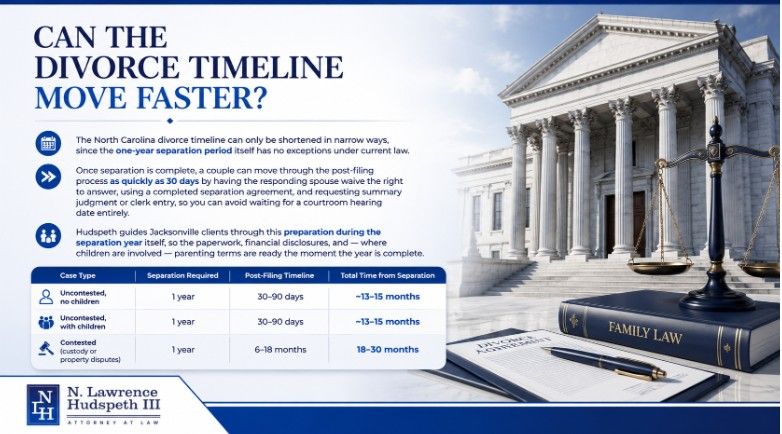
The North Carolina divorce timeline can only be shortened in narrow ways, since the one-year separation period itself has no exceptions under current law.
Once separation is complete, a couple can move through the post-filing process as quickly as 30 days by having the responding spouse waive the right to answer, using a completed separation agreement, and requesting summary judgment or clerk entry, so you can avoid waiting for a courtroom hearing date entirely.
Hudspeth guides Jacksonville clients through this preparation during the separation year itself, so the paperwork, financial disclosures, and — where children are involved — parenting terms are ready the moment the year is complete.
| Case Type | Separation Required | Post-Filing Timeline | Total Time from Separation |
| Uncontested, no children | 1 year | 30–90 days | ~13–15 months |
| Uncontested, with children | 1 year | 30–90 days | ~13–15 months |
| Contested (custody or property disputes) | 1 year | 6–18 months | 18–30 months |
| Onslow County Filing Step | Typical Timing |
| Complaint filed with the Clerk of the Superior Court | Day 1 |
| Spouse served, response window opens | Within days of filing |
| Response deadline (or waiver) | 30 days after service |
| Hearing scheduled via Onslow County Calendaring Request | 6–8 weeks after response window closes |
| Final decree (uncontested) | 2–4 months after filing |
Protect your separation year before it costs you equitable distribution or custody rights — schedule a confidential consultation with Hudspeth to build your timeline correctly from day one.
If you’re ready to get started, call us now!
How long must you be separated before filing for divorce in North Carolina?
North Carolina requires spouses to live separate and apart for one full year before either party can file for absolute divorce. This requirement comes from N.C. Gen. Stat. § 50-6 applies without exception under current North Carolina law, regardless of the circumstances.
Does the one-year separation clock restart if we get back together?
Yes. If spouses resume living together during the separation period, even briefly, the one-year clock restarts entirely from that date under North Carolina law. Isolated incidents of intimacy alone do not restart the clock, but resuming full cohabitation legally does.
How long does an uncontested divorce take after filing in North Carolina?
Most uncontested North Carolina divorces are finalized within 30 to 90 days after filing, once the one-year separation period is already fully complete. The exact final timeline generally depends on the county’s court calendar, docket volume, and overall case complexity.
How long does a contested divorce take in North Carolina?
Contested divorces involving child custody, alimony, or marital property disputes typically take 8 to 18 months or longer to fully resolve. Each disputed issue is litigated separately from the divorce itself, significantly extending the overall case timeline in most cases.
How long does divorce take in Onslow County specifically?
Onslow County uncontested divorces in North Carolina generally take 2 to 4 months from filing to final decree. Local Fourth Judicial District rules require a completed calendaring request, and scheduling depends on the district court’s current docket volume and calendar.
Do I need to attend a hearing to finalize my divorce in North Carolina?
Not always in every North Carolina case. Many uncontested cases proceed through summary judgment or clerk entry without an in-person hearing at all. When a hearing is required, it typically lasts only 5 to 15 minutes and confirms separation and residency facts.
Does equitable distribution delay the divorce judgment itself?
No. Equitable distribution is litigated separately from the divorce judgment, so it does not delay the dissolution of the marriage. However, the equitable distribution claim must be raised before the divorce is finalized, or it is permanently lost under North Carolina law.
Can military families use a different residency rule to file in North Carolina?
Yes. Under N.C. Gen. Stat. § 50-18, a servicemember stationed in North Carolina for six months can satisfy the residency requirement even without establishing civilian domicile, allowing filing at bases like Camp Lejeune or MCAS New River in Onslow County.
What is the fastest possible timeline for a North Carolina divorce?
The fastest realistic timeline is about 13 months total — one year of separation plus roughly 30 days for an uncontested filing where the responding spouse waives their right to answer, and both parties use a complete, signed separation agreement from the start.
Does the county I file in affect how long my divorce takes?
Yes. Court scheduling varies significantly depending on each county’s docket volume, judges’ availability, and local procedural rules. Larger North Carolina counties often have dedicated uncontested divorce sessions, while smaller districts, such as Onslow County, process cases on a rolling civil calendar.
Facing the one-year wait alone makes it harder to protect what matters — Hudspeth helps Jacksonville clients use the separation period to prepare a strong, complete case from the start.
Office

Links