


A family law mediation in North Carolina is a scheduled settlement conference where both parties, their attorneys, and a neutral certified mediator work through unresolved custody or financial claims before trial.
The mediator controls the format, carries offers between the parties, and makes no decisions. Conferences are commonly booked for a half day or a full day.
Custody claims and family financial matters run through two separate court programs with different rules, different costs, and different drafting duties.
Uncertainty about a first mediation session ends with preparation. Hudspeth Family Law helps Onslow County families arrive ready to negotiate — schedule a confidential consultation.
Mediation is mandatory in most contested North Carolina family cases, but the requirement comes from two different statutes covering two different subject areas.
Contested custody and visitation claims fall under the Custody and Visitation Mediation Program. Equitable distribution and related money claims fall under the Family Financial Settlement Program.
Under N.C. Gen. Stat. § 50-13.1(b), a district court sets contested custody and visitation issues for mediation before or concurrent with the hearing date unless the court waives mediation for good cause under subsection (c).
The same statute bars alimony, child support, and other economic issues from that program.
Financial claims instead proceed under N.C. Gen. Stat. § 7A-38.4A(c), which authorizes a chief district court judge to order a mediated settlement conference in any pending action involving equitable distribution, alimony, child support, or post-separation support.
| Track | Claims covered | Required? | Who pays the mediator |
| Custody and Visitation Mediation Program | Custody and visitation only | Mandatory in contested cases unless waived for good cause under § 50-13.1(c) | No charge to the parties; mediators are court staff or court-contracted |
| Family Financial Settlement Program | Equitable distribution, alimony, child and post-separation support | FFS Rule 1(c)(1) requires the scheduling order to include a conference in equitable distribution cases; mediation is the default procedure | The parties, in equal shares unless ordered otherwise under FFS Rule 7(d) |
| Private or pre-litigation mediation | Any issue the parties agree to negotiate | Voluntary | The parties, at rates set by agreement under FFS Rule 7(a) |
Parties who mediate before filing keep the most control over timing, mediator selection, and cost.
The Dispute Resolution Commission also notes that a motion to waive court-ordered mediation stands a better chance when the earlier attempt involved a certified mediator, since a judge may deny the motion where the first neutral held no certification.
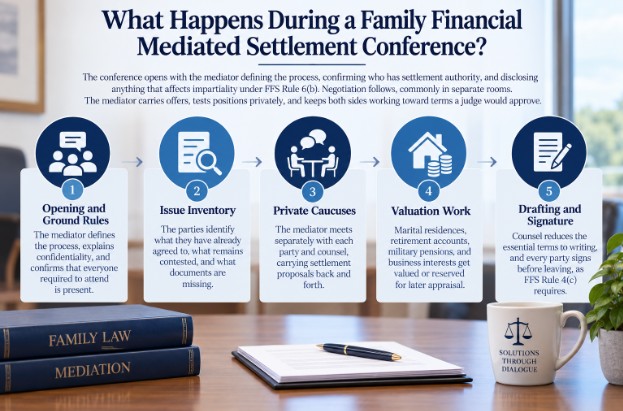
The conference opens with the mediator defining the process, confirming who has settlement authority, and disclosing anything that affects impartiality under FFS Rule 6(b). Negotiation follows, commonly in separate rooms.
The mediator carries offers, tests positions privately, and keeps both sides working toward terms a judge would approve.
A family financial conference generally moves through this sequence:
Recording the conference is prohibited under FFS Rule 4(e), including recording done surreptitiously and recording done with the agreement of the parties.
Attendance defaults to in person under Rule 4(a)(2) unless the mediator’s Dispute Resolution Commission profile designates remote-only practice, or the parties agree on another method.
The Commission’s guide for unrepresented parties notes that most conferences are scheduled for either a half day or a full day in the county where the case is filed.
Families weighing the surrounding timeline often review the full divorce process in North Carolina before selecting a settlement date.
If you’re ready to get started, call us now!
The mediator is a neutral. The attorney is an advocate. Confusing the two roles is the most common misunderstanding families bring to a first conference.
Drafting authority differs sharply between the two programs, and the distinction matters at the moment of signature.
A family financial mediator may not give legal advice, and the North Carolina State Bar treats drafting as legal advice. That mediator may act as a scribe — copying terms word for word as the attorneys dictate them — only when every named party attends represented by counsel.
A custody program mediator operates under different rules: where the parties reach a parenting agreement, the custody mediator prepares the written agreement for signature.
| Function | Certified mediator | Party’s attorney |
| Neutrality | Required; must disclose any relationship affecting impartiality (FFS Rule 6(b)(2)) | Advocates for one party only |
| Legal advice | Prohibited under the Standards of Professional Conduct | Core responsibility |
| Deciding the outcome | No authority; parties decide | No authority; advises on risk |
| Drafting | Family financial mediator prohibited except as scribe; custody mediator prepares the parenting agreement | Drafts and reviews terms |
| Reporting to the court | Files the Report of Mediator within 10 days under FFS Rule 6(b)(4) | Files consent orders and dismissals |
Attorneys carry their own duties, including advising the client about settlement procedures upon being retained under Rule 1(b), helping schedule before the court deadline, and paying the mediator’s fee at the completion of the conference.
Parties heading toward a contested custody hearing benefit from understanding both roles before the session begins.
Missed mediation deadlines invite sanctions and delay. Larry Hudspeth guides Onslow County families through family financial conferences — request mediation guidance today.
Certification by the North Carolina Dispute Resolution Commission determines who may mediate a court-ordered family financial case.
The Commission certifies mediators for five court-based programs and regulates them under the Standards of Professional Conduct for Mediators, which govern impartiality, confidentiality, and conflicts of interest.
Certification carries three practical consequences. A court can appoint only a mediator certified in the relevant program, so an uncertified neutral cannot take a court referral. A prior family financial settlement attempt before a certified mediator strengthens a later motion to waive.
And Standard 7 bars a mediator who is also a lawyer from later representing any party in a matter arising out of the mediated dispute, a restriction that extends to the mediator’s professional partners and co-shareholders.
Hudspeth holds Dispute Resolution Commission certification in both Family Financial and Superior Court matters. That dual footing matters in Onslow County, where a single case can pair military pension division with a related civil claim.
If you’re ready to get started, call us now!
Court-appointed family financial mediators charge $150 per hour plus a one-time $175 administrative fee under FFS Rule 7(b), and may not bill travel or expenses.
The administrative fee accrues on appointment and remains due even when the case settles, is dismissed, or ends in default judgment. Party-selected mediators set their own rates by agreement.
| Cost item | Mediated settlement route | Contested trial route |
| Mediator fee (court-appointed) | $150 per hour, split equally | Not applicable |
| Administrative fee | $175 one-time, due at appointment | Not applicable |
| Custody mediation | No charge to the parties under the court program | Not applicable |
| Attorney time | Concentrated in one preparation cycle and one conference | Discovery, motions, pretrial, multi-day hearing |
| Timeline | Weeks between order and conference | Months to over a year on the district court calendar |
| Privacy | Negotiations confidential and inadmissible under § 7A-38.4A(j) | Testimony and exhibits enter the public record |
The fee split is court-ordered, not optional. A party who fails to pay faces a show cause motion under FFS Rule 5 and the court’s contempt powers, with sanctions that can include the unpaid fee, fines, attorney fees, and lost earnings for everyone who attended.
A party genuinely unable to pay may petition for relief using form AOC-CV-814. The published Attorney’s Guide to Mediation sets out these provisions, and the firm’s analysis of mediation and litigation offers a fuller comparison.
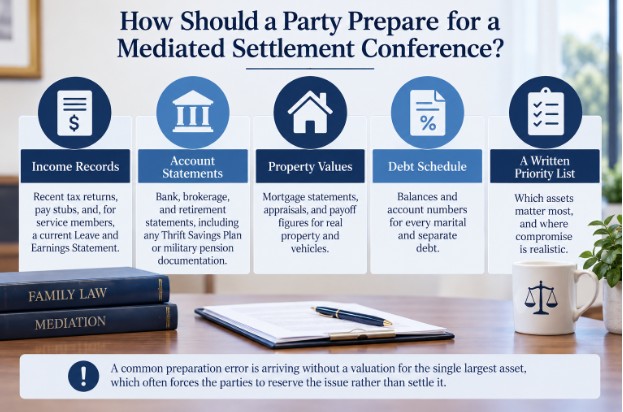
Preparation determines how much of the conference gets spent negotiating rather than hunting for numbers. Documents assembled in advance let the mediator work with real figures from the first caucus.
Two preparation errors surface repeatedly. The first is arriving without a valuation for the single largest asset, which forces the parties to reserve the issue rather than settle it.
The second is treating child support as negotiable in the abstract when the North Carolina Guidelines already dictate a presumptive figure from income and overnight counts.
Enforceability arrives in two stages, and conflating them causes real problems later. A settlement document signed at the conference binds the parties immediately as a written contract.
Court-order remedies, including contempt, become available only once a judge enters a consent order, judgment, or incorporated parenting agreement.
The sequence runs as follows. Parties reduce the essential terms to writing and sign before leaving.
Counsel notifies the court of the settlement and files the consent order, judgment, or voluntary dismissal.
In custody matters, the mediator prepares the parenting agreement, the parties sign, and the court incorporates it into an enforceable order unless the judge finds good reason otherwise.
Financial terms reached through the family financial program follow the parallel path into a district court order.
Incomplete terms create the largest downstream risk. The Dispute Resolution Commission warns that an agreement leaving material terms to be finalized later may prove unenforceable, and that the mediator has no duty to alert counsel when an essential term is missing. Precision matters most in retirement division, alimony duration, and support calculations, where a vague clause reopens the dispute a year later.
If you’re ready to get started, call us now!
Is mediation mandatory in every North Carolina family law case?
Not every case. North Carolina requires custody mediation in contested custody and visitation matters and a settlement procedure in equitable distribution cases. Simple absolute divorce filings with no contested custody or financial claims carry no statutory mediation requirement under state law.
How long does a family financial mediated settlement conference last?
Most family financial conferences are scheduled for either a half day or a full day, in the county where the case is filed. Complex equitable distribution cases involving business valuations or military pensions sometimes recess and reconvene on another date.
Do both spouses stay in the same room during mediation?
Not necessarily. The mediator controls the format and commonly places each party in a separate room, moving between them with offers. Parties who prefer a joint session may request one, and remote attendance is available when the mediator’s profile allows it.
Can a mediator give legal advice or draft the agreement?
Family financial mediators may not give legal advice, and drafting counts as legal advice; a mediator may act as scribe only when all parties have counsel. Custody program mediators, by contrast, prepare the written parenting agreement themselves under the program rules.
What happens if one party refuses to attend the conference?
The party who complies should still attend. The mediator files a Report of Mediator listing everyone present, and a district court judge may impose contempt sanctions, fines, lost wages, and attorney fees against the person who failed to appear without good cause.
Is anything said in mediation admissible later in court?
Statements and conduct in a family financial settlement conference are generally inadmissible, and the mediator cannot be compelled to testify about them. Narrow exceptions cover sanctions motions, State Bar discipline, and proceedings enforcing juvenile or elder abuse laws under the FFS statute.
Can custody mediation resolve child support at the same time?
No. The custody mediation program addresses custody and visitation only. North Carolina law bars referral of alimony, child support, and other economic issues to that program; those claims move through the family financial settlement track, where financial claims belong under state law.
Is a mediated agreement binding before a judge signs it?
A signed settlement document binds the parties as a written contract from the moment of signature. Court-order remedies, including contempt, become available only after a judge enters a consent order, judgment, or incorporated parenting agreement in the case file.
What happens when mediation ends without a full agreement?
The mediator declares an impasse and reports the outcome to the court. Issues settled during the conference can still be written into a partial agreement, leaving fewer contested claims for a district court judge to decide later in the case.
Property, custody, and support decisions outlast the divorce itself. Larry Hudspeth brings 45 years of family law experience to every conference — start the conversation today.
Office

Links