


Grandparents’ custody and visitation rights in North Carolina offer limited routes for a grandparent to ask a district court for custody of, or time with, a grandchild over a parent’s objection.
N.C.G.S. § 50-13.1(a) lets any relative file for custody, but a grandparent opposing a parent must allege unfitness or conduct inconsistent with constitutionally protected parental status.
Statutory visitation is narrower, usually requiring an ongoing parental custody dispute or a qualifying adoption, so the chosen route matters as much as the bond behind a child custody claim.
The wrong statute can end a grandparent’s case early. Larry Hudspeth reviews the family’s facts and any court file in a case review.
Grandparents can file for custody because § 50-13.1(a) allows relatives to bring custody actions. Against a parent, the claim moves through three stages, each with its own test.
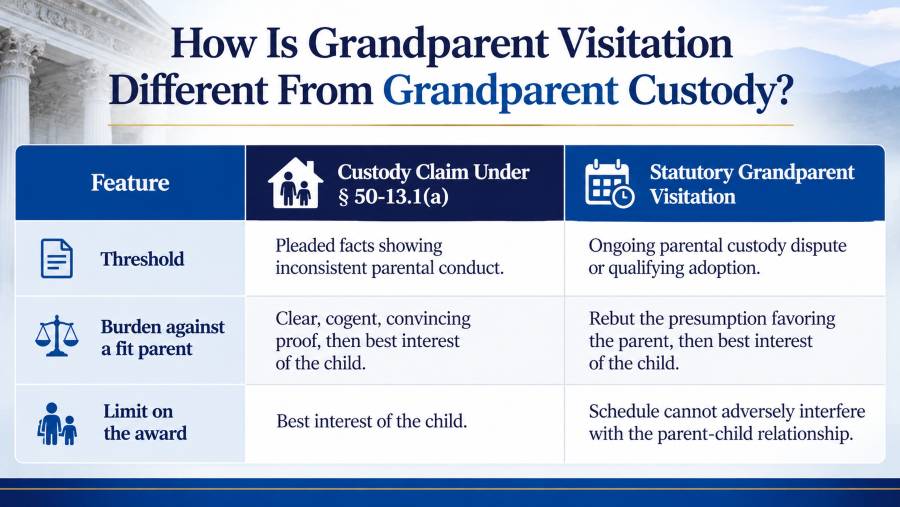
Grandparent custody places a child with a grandparent; grandparent visitation grants scheduled time and leaves custody with a parent.
| Feature | Custody Claim Under § 50-13.1(a) | Statutory Grandparent Visitation |
| Threshold | Pleaded facts showing inconsistent parental conduct | Ongoing parental custody dispute or qualifying adoption |
| Burden against a fit parent | Clear, cogent, convincing proof, then best interest | Rebut the presumption favoring the parent, then best interest |
| Limit on the award | Best interest of the child | Schedule cannot adversely interfere with the parent-child relationship |
A grandparent seeking placement follows the same path as any nonparent pursuing sole custody against a parent.
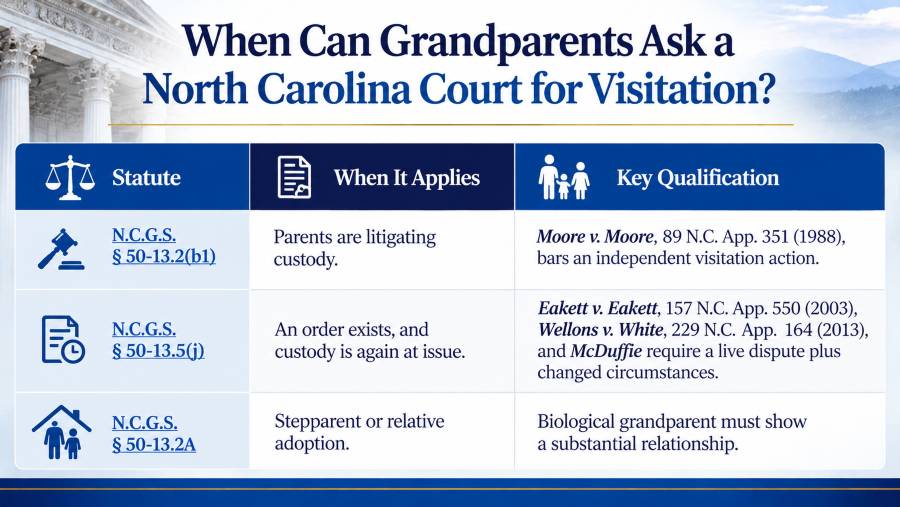
North Carolina grandparents can seek statutory visitation through three provisions, none of which allows a standalone suit against an intact family. Appellate courts treat a single parent, or a remarried parent and stepparent, living with the child as intact.
| Statute | When It Applies | Key Qualification |
| N.C.G.S. § 50-13.2(b1) | Parents are litigating custody | Moore v. Moore, 89 N.C. App. 351 (1988), bars an independent visitation action |
| N.C.G.S. § 50-13.5(j) | An order exists, and custody is again at issue | Eakett v. Eakett, 157 N.C. App. 550 (2003), Wellons v. White, 229 N.C. App. 164 (2013), and McDuffie require a live dispute plus changed circumstances |
| § 50-13.2A | Stepparent or relative adoption | Biological grandparent must show a substantial relationship |
A dormant order is usually not enough. Eakett rejected a § 50-13.5(j) claim filed more than a year later with no parental dispute pending. The analysis shifts when the order already placed the child with a nonparent: Fecteau v. Spierer, 277 N.C. App. 1 (2021), treated that modification as a question of changed circumstances and best interest under § 50-13.7. Posture matters more than any single general rule.
A later custody filing by either parent, often joined with a divorce, opens the § 50-13.2(b1) route.
If you’re ready to get started, call us now!
A grandparent’s legal route depends on four facts:
In a hypothetical, two Onslow County grandmothers each kept a grandchild every weekend until contact stopped. One grandmother’s son is litigating custody, which may open a route to intervene, though the motion must be timely and visitation still requires rebutting the presumption favoring the parent.
The other’s daughter is a fit single parent with no pending case, so the same bond supports no statutory claim.
A substantial relationship is the bond a biological grandparent must prove to seek visitation after a stepparent or relative adoption under N.C.G.S. § 50-13.2A. The statute does not define the term, so evidence of past involvement controls.
A substantial relationship and a best interest finding are separate questions. In Hill v. Newman, 131 N.C. App. 793 (1998), a grandmother who helped raise the children from birth cleared the relationship threshold, yet lost on visitation because she could not accept the adoptive parents’ role.
Overnight care, school or medical involvement, financial support, and records of regular contact speak to the relationship; the judge decides separately whether a schedule serves the child.
Grandparents facing a refusal need the right statute first. Larry Hudspeth tests each route against the family’s timeline, so request a consultation.
Troxel v. Granville, 530 U.S. 57 (2000), requires special weight for a fit parent’s decision about the child’s associations.
The UNC School of Government’s judicial training materials connect these cases, and a parent’s attorney will raise them in contested custody litigation.
Grandparents intervene by filing a motion under Rule 24 of the North Carolina Rules of Civil Procedure while the parents’ dispute remains open and serving every party with a pleading stating the claim.
Rule 24 requires a timely application. Quesinberry v. Quesinberry, 196 N.C. App. 118 (2009), kept alive a claim filed before the parents’ consent judgment; a first filing after settlement loses that route.
Contested issues then go to custody mediation under § 50-13.1(b) where a district program exists.
The Hudspeth practice represents military families near Camp Lejeune. Under N.C.G.S. § 50-13.2(f), a court may weigh a deployment’s significant impact on the child but cannot make deployment the sole basis for a best interest ruling.
If you’re ready to get started, call us now!
Grandparents do not have automatic visitation rights in North Carolina. A grandparent must qualify under a specific statute, such as an ongoing parental custody case or a stepparent adoption, and must overcome the presumption that a fit parent’s decision is correct.
Grandparents generally cannot get court-ordered visitation when the parents are married and living together with no custody case pending. McIntyre v. McIntyre treats that household as an intact family, and North Carolina courts dismiss grandparent visitation suits filed against intact families.
Grandparents can seek custody when a parent is unfit, has neglected the child, or has abandoned the child. The grandparent must plead specific facts and later prove, by clear, cogent, and convincing evidence, that the parent’s conduct warrants the court’s consideration of the child’s best interest.
Under North Carolina case law, a single parent living with a child counts as an intact family. Grandparents therefore cannot sue a single parent for visitation alone; they need an ongoing custody case, a qualifying adoption, or allegations of parental unfitness.
The answer depends on timing. If no case is pending, the surviving parent gains custody and controls visitation. Grandparents who intervened before the death, or who already held a visitation order, may continue pursuing visitation within that existing custody case in district court.
Biological grandparents can seek visitation after a stepparent or relative adoption under N.C.G.S. § 50-13.2A. The grandparent must show a substantial relationship with the child, and the judge must enter written findings that the visitation serves the child’s best interest.
A motion under N.C.G.S. § 50-13.5(j) requires changed circumstances and a live custody dispute, so a dormant order rarely reopens a fit parent’s household. Where a nonparent already has custody, Fecteau shows modification turns on changed circumstances and the child’s best interest instead.
Onslow County grandparents file custody or visitation claims in Onslow County District Court when the child lives there. North Carolina district court judges hear custody matters without a jury, and venue generally follows the county where the child or a parent resides.
Custody claims require proven conduct inconsistent with protected status, while statutory visitation depends on an ongoing parental dispute or a qualifying adoption.
Troxel, Graham, and Alexander require deference to fit parents, so timing and statute choice decide most grandparent cases.
A consultation with Larry Hudspeth covers the fitting statute, any pending case, and the evidence worth gathering. Review grandparent options today.
Office

Links