


High-asset divorce in Jacksonville, NC describes a separation where the marital estate holds a closely held business, a military pension, retirement accounts, or multiple properties, so classification and valuation decide more than the percentage split.
North Carolina courts presume an equal division of net marital and divisible value under N.C.G.S. § 50-20(c), but that presumption reaches only property the court first classifies as divisible, which is why equitable distribution in a complex estate turns on evidence rather than arithmetic.
Account statements and business records make a first meeting productive. Larry Hudspeth uses them to spot valuation issues early, so schedule a case review.
A high-asset divorce is one where valuation and classification disputes, not the division percentage, drive the outcome.
Military families near Camp Lejeune and MCAS New River often hold that mix: a service pension, a Thrift Savings Plan balance, a spouse-run business, and homes bought across duty-station moves.
Under N.C.G.S. § 50-11(e), an absolute divorce entered in North Carolina ends the right to equitable distribution unless a spouse asserted the claim before the divorce judgment.
A defendant served by publication who did not appear may file within six months of the judgment, and subsection (f) adds a similar window when the divorcing court lacked personal jurisdiction over the absent spouse.
Onslow County equitable distribution claims are heard in the Fourth Judicial District, and most contested claims route through family financial mediation before any hearing.
North Carolina mandates no single method for valuing a closely held business or practice. In Poore v. Poore, 75 N.C. App. 414 (1985), the Court of Appeals held that the approach depends on the practice’s facts and that a sound method applied to competent evidence controls.
Poore requires four components:
Goodwill is the value a business carries beyond its tangible assets, driven by reputation, client relationships, and earning history.
Poore treats goodwill as a factual question for expert testimony and lists the practitioner’s age, health, reputation, length of practice, past profits, and comparative success among the considerations.
Recognized methods include market value, capitalization of excess earnings (profit above a normal salary), a percentage of average gross income, and comparable sales. Any method must measure present value from past results, not the owner’s future effort.
Under N.C.G.S. § 50-21, marital property carries its separation-date value, while divisible property, meaning post-separation value changes not caused by either spouse’s effort, is measured at distribution.
Consider a hypothetical: a dental practice worth $800,000 at separation is worth $1,000,000 two years later.
If a regional market rise produced the gain, the $200,000 is likely divisible and shared. If the owner added a second chair and worked extra hours, that growth traces to post-separation effort and generally stays with the owner.
If you’re ready to get started, call us now!

Classification comes before division and usually holds the largest dollar disputes. N.C.G.S. § 50-20(b) sorts every asset into one of three categories, and the statute’s presumptions can be overcome by the greater weight of the evidence.
| Category | What the Statute Covers | High-Asset Examples |
| Marital | Property either spouse acquired during the marriage and before separation that is still owned | Business formed during the marriage, pension credits earned during the marriage, jointly titled real estate |
| Separate | Property owned before marriage or received by inheritance or gift during it, plus its appreciation and income | Premarital business interest, inherited brokerage account, premarital down payment traced to closing |
| Divisible | Passive post-separation value changes, post-separation receipts earned before separation, passive income from marital property, and passive debt changes | Bonus earned before separation, market gain on a marital account, interest accruing on marital debt |
Tracing means following separate money through accounts and purchases with documents, and it decides most separate-property claims in a complex divorce.
Suppose a spouse inherited $150,000, deposited it in a joint account, and used it at a home closing. Bank records showing both transactions can often trace the inheritance to the home; without them, the court may treat the funds as marital.
A gift between spouses counts as separate property only when an express written statement of intent accompanies it.
Two legal systems govern a military pension. North Carolina law decides how much of the pension is marital and each spouse’s share; federal law decides how much DFAS can pay and whether it pays the former spouse directly.
| North Carolina Rule | What It Decides |
| Coverture fraction under N.C.G.S. § 50-20.1(d) | The marital portion: months of service during the marriage and before separation, divided by total months of service earning the pension |
| 50% limit under § 50-20.1(e) | The award generally cannot exceed half the benefits unless other marital assets are insufficient, a business or professional interest is hard to divide, keeping an asset intact is economically desirable, multiple plans exist (50% of the combined total), or both spouses consent |
| No minimum marriage length | Retirement pay earned during the marriage is divisible regardless of how long the marriage lasted. |
| Federal Rule | What It Decides |
| 10/10 rule under 10 U.S.C. § 1408 | DFAS pays the former spouse directly only when the marriage overlapped at least 10 years of creditable service |
| Payment ceiling | DFAS direct payments for property division cannot exceed 50% of disposable retired pay, or 65% combined with support withholding under 42 U.S.C. § 659 |
| Frozen benefit rule | For divorces entered after December 23, 2016 and final before retirement, the pay base is limited to basic pay at the member’s grade and years of service on the order date, plus retiree cost-of-living adjustments |
| Acceptable award format | A fixed dollar amount, a percentage of disposable retired pay, or an acceptable formula or hypothetical award for a member still on active duty |
When the marriage overlapped fewer than 10 years of service, the former spouse still owns the awarded share; the retiree pays it, and enforcement runs through the state court. Direct-payment applications go to DFAS on DD Form 2293 with a certified order.
Survivor Benefit Plan coverage is not automatic: the order should address it, and the former spouse must file the required election with DFAS.
In Howell v. Howell (2017), the United States Supreme Court held that a state court cannot order a veteran to reimburse a former spouse for retired pay waived to receive VA disability benefits.
The Court noted that family courts may account for a possible future waiver when dividing other assets or setting alimony.
The Thrift Savings Plan is divided through a retirement benefits court order, not a qualified domestic relations order, because federal law rather than ERISA governs the plan. Under Thrift Savings Plan court order guidance, some terms apply automatically, and others depend on the order or the account.
The order must name the plan exactly as the “Thrift Savings Plan” and cannot dictate an earnings rate or rollover instructions.
Civilian defined-contribution plans and IRAs follow N.C.G.S. § 50-20.1(d1): the marital share traces contributions made during the marriage and before separation, plus their gains and losses, with the coverture fraction as fallback.
Retirement orders that a plan rejects delay payment for months. Larry Hudspeth reviews each plan’s requirements before signing, so request a consultation early.
Real estate rarely divides cleanly, so North Carolina courts weigh occupancy, liquidity, and taxes together rather than ordering a sale by default: a custodial parent’s need for the residence under N.C.G.S. § 50-20(c)(4), liquidity under (c)(9), and tax consequences under (c)(11).
| Option | When It Tends to Work | Main Risk |
| Retain with offsetting assets | The retaining spouse can give up other marital assets of equal value | Trading liquid retirement funds for an illiquid home |
| Refinance and buy out | The retaining spouse qualifies alone for a new mortgage | Higher mortgage rates raise the payment above the old loan |
| Sell and split proceeds | Neither spouse can carry the home alone, or both want liquidity | Closing costs and tax consequences reduce the net |
Military households add a layer: a home bought during a Camp Lejeune tour and rented from a later duty station can mix marital acquisition, separate contribution, and post-separation management, each needing its own proof.
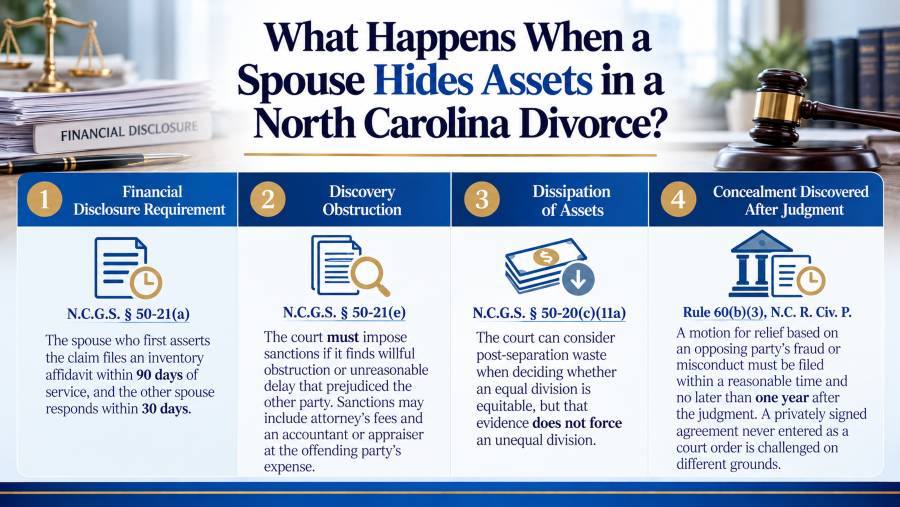
North Carolina offers several remedies for concealment, each with its own legal standard, and none is automatic. Disclosure starts with § 50-21(a): the spouse who first asserts the claim files an inventory affidavit within 90 days of service, and the other spouse responds within 30 days.
Records gathered early make full financial disclosure enforceable. Forensic accounting turns suspicion into evidence through lifestyle analysis, comparing business distributions with reported income, and tracing transfers made shortly before separation.
If you’re ready to get started, call us now!
A premarital business begins as separate property, but marital labor and reinvested marital earnings can create a marital component subject to division. Records of the business’s value at the wedding date and of contributions during the marriage determine how much remains separate.
The former spouse still receives the awarded share of military retired pay. DFAS will not pay it directly, so the retiree pays the former spouse personally, and the North Carolina court that entered the order enforces missed payments.
No. Howell v. Howell bars state courts from ordering a veteran to reimburse a former spouse for retired pay waived to receive VA disability benefits. Family courts may still consider that risk when dividing other marital assets or setting support amounts.
Generally no. N.C.G.S. § 50-11(e) ends the right unless the claim was asserted before the divorce judgment. A narrow six-month exception applies to a defendant served by publication who never appeared, and to certain personal jurisdiction defects in the divorce.
No. North Carolina presumes an equal division of net marital and divisible value, but either spouse can rebut that presumption with evidence. The court then weighs twelve statutory factors, including liquidity, tax consequences, and post-separation waste, to reach an equitable division.
Timelines depend on appraisals, discovery, and mediation rather than the court calendar alone. Inventory affidavits are due within 90 days of service, and expert valuation of a closely held business or professional practice typically extends the schedule by several months.
It can. Section 50-21(e) requires sanctions after the court finds willful obstruction that prejudiced the other spouse, and the court may weigh post-separation waste in deciding whether an equal division is equitable. Neither consequence applies automatically, and both require proof.
North Carolina requires mediation before most contested equitable distribution claims reach a hearing. Spouses may select their own certified family financial mediator, and the court appoints one when the parties cannot agree on a choice.
A high-asset divorce in Jacksonville turns on preparation: filing the equitable distribution claim before the divorce judgment, tracing and documenting separate property, valuing a business with a sound method, and drafting retirement orders that DFAS and the Thrift Savings Plan will accept.
Each step depends on early record-gathering and becomes harder to fix after judgment.
Larry Hudspeth reviews statements, business records, and service history to identify which assets need valuation. Book a confidential consultation today.
Office

Links