

North Carolina has no alimony calculator. No worksheet, no percentage, no multiplier. A district court judge first decides entitlement, then weighs sixteen statutory factors under N.C. Gen. Stat. § 50-16.3A(b) to set the amount, duration, and payment method.
One narrow category of misconduct — illicit sexual behavior before separation — can decide the outcome before that weighing begins.
Anyone facing an alimony claim in Jacksonville should expect a fact-driven hearing, not an arithmetic exercise.
Alimony exposure surprises supporting spouses late in a case. Hudspeth Family Law maps that risk early for Onslow County families — schedule a confidential consultation.
No formula exists. Section 50-16.3A(b) directs the court to exercise discretion in determining amount, duration, and manner of payment, then lists sixteen factors the judge must consider. Nothing in Chapter 50 assigns weights, ratios, or income percentages.
That distinction separates alimony from child support, where the North Carolina Child Support Guidelines produce a presumptive figure from income and overnight counts.
You can estimate a child support obligation before anyone walks into the courthouse. An alimony award cannot.
Three consequences follow:
Entitlement precedes calculation. Under section 50-16.1A, a dependent spouse is one who is actually substantially dependent on the other for maintenance and support, or substantially in need of maintenance and support from the other. A supporting spouse is the mirror image.
Earning an income does not by itself defeat dependency. The test measures need and actual dependence against the standard of living the marriage established, so a spouse with a respectable salary married to a far higher earner may still qualify.
A stay-at-home spouse with no earnings is the clearest case, not the only one.
Section 50-16.3A(a) then requires three findings before any award is issued: that one spouse is dependent, that the other is supporting, and that an award is equitable after considering all relevant factors. Failure on any of the three ends the claim.
Postseparation support under section 50-16.2A runs on a narrower financial-needs test and covers the interim before the alimony claim is heard, which is why many Onslow County cases resolve temporary support months before the alimony hearing.
If you’re ready to get started, call us now!
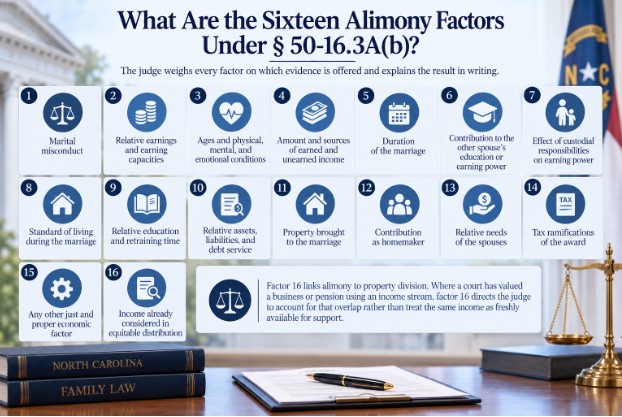
The statute lists sixteen considerations. The judge weighs every factor on which evidence is offered and explains the result in writing.
| Factor | Statutory language | What it means in practice |
| 1 | Marital misconduct of either spouse | Conduct defined in § 50-16.1A(3); post-separation conduct may corroborate pre-separation misconduct |
| 2 | Relative earnings and earning capacities | Actual income plus what each spouse could reasonably earn |
| 3 | Ages and physical, mental, and emotional conditions | Health limits on working and the cost of care |
| 4 | Amount and sources of earned and unearned income | Wages, dividends, and benefits including medical, retirement, insurance, and Social Security |
| 5 | Duration of the marriage | One input among sixteen, not a multiplier |
| 6 | Contribution to the other spouse’s education or earning power | Support given while a spouse earned a degree, license, or credential |
| 7 | Effect of custodial responsibilities on earning power | How caring for a minor child limits hours, travel, or advancement |
| 8 | Standard of living during the marriage | The lifestyle the household actually maintained, documented rather than described |
| 9 | Relative education and retraining time | How long the spouse seeking alimony needs to become self-supporting |
| 10 | Relative assets, liabilities, and debt service | What each spouse owns and owes, including support owed to others |
| 11 | Property brought to the marriage | Separate assets each spouse arrived with |
| 12 | Contribution as homemaker | Unpaid household and caregiving work treated as a real contribution |
| 13 | Relative needs of the spouses | Documented monthly expenses measured against income |
| 14 | Tax ramifications of the award | Federal, state, and local tax effects on both parties |
| 15 | Any other just and proper economic factor | The catch-all for circumstances the first fourteen miss |
| 16 | Income already considered in equitable distribution | Addresses income used to value a marital or divisible asset |
Factor 16 links alimony to property division. Where a court has valued a business or pension using an income stream, factor 16 directs the judge to account for that overlap rather than treat the same income as freshly available for support.
Sequencing therefore becomes a strategic question, and section 50-16.3A(a) expressly permits the alimony claim to be heard before equitable distribution, with amount and dependency status reviewable afterward.
Sixteen factors give a judge wide latitude. Larry Hudspeth has argued alimony claims in Onslow County courtrooms for decades — request alimony guidance today.
If you’re ready to get started, call us now!
Illicit sexual behavior occupies a category of its own. Section 50-16.3A(a) sets three rules, and each uses mandatory language:
Condonation defeats the bar. Any act of illicit sexual behavior condoned by the other party cannot be considered by the court.
Every other category of marital misconduct works differently. Abandonment, cruel treatment, indignities, reckless spending or waste of assets, excessive use of alcohol or drugs, and willful failure to provide subsistence are defined in § 50-16.1A(3), but they carry no automatic consequence.
They enter through factor 1 and get weighed alongside the other fifteen. Either spouse may also request a jury trial on the issue of marital misconduct under § 50-16.3A(d).
Duration is discretionary. Section 50-16.3A(b) states that an award may run for a specified term or an indefinite one, and § 50-16.3A(c) requires the judge to explain the duration chosen.
No North Carolina statute or judicial rule ties duration to marriage length. Informal fractions of the marriage circulate among practitioners; none binds a district court judge or appears in the statute.
Retraining time, health and age, custodial responsibility, and income-producing assets received in distribution all push duration in one direction or the other.
Payment method is equally flexible, since § 50-16.7 permits lump sum payment, periodic payments, income withholding, or transfer of title or possession of property.
Section 50-16.9 governs what happens next. A court may modify or vacate an alimony order on a showing of changed circumstances, with the burden on the party seeking the change.
Where the support is paid under a judgment or order of a North Carolina court, three events terminate it: the death of either spouse, the remarriage of the dependent spouse, or cohabitation, which the statute defines as two adults dwelling together continuously and habitually with the voluntary mutual assumption of marital rights and duties.
A motion premised on the parties resuming marital relations while still married runs under § 52-10.2 instead.
Two limits catch parties off guard. A completed lump sum award or property transfer does not unwind when the recipient later remarries. And whether the court can modify support at all depends on the instrument.
Support set by an unincorporated separation agreement is a contract, alterable by the parties’ consent or under contract principles rather than by motion under § 50-16.9.
Support incorporated into a court order falls within the court’s modification authority. Which instrument controls is the first question in any modification review, and it is worth settling before a contested hearing gets scheduled.
Two separate questions arise in every military alimony case, and conflating them produces unenforceable orders. The first is what counts as income when a North Carolina judge sets the award.
The second is what federal law allows to be collected once the order exists. Camp Lejeune and MCAS New River give this issue a steady presence on the Onslow County docket.
On the first question, military compensation reaches the analysis through factor 4, which covers the amount and sources of earned and unearned income, including benefits.
A judge reviewing a Leave and Earnings Statement looks at total compensation rather than base pay alone.
On the second, federal rules narrow considerably:
| Pay component | Counts as income under factor 4 | Reachable by federal support garnishment |
| Basic pay | Yes | Yes |
| BAH, BAS, family separation allowance | Yes, as part of the compensation picture | No — the North Carolina State Bar’s LAMP materials state that allowances are not garnishable |
| Special and incentive pay | Yes, with a longer look-back than one month | Yes, as part of disposable earnings |
| Military retired pay | Yes | Yes, subject to Consumer Credit Protection Act ceilings |
| VA disability compensation | Generally not divisible as property | Only to the extent it replaces waived retired pay |
Three federal limits deserve precision. Garnishment reaches disposable earnings, meaning gross pay less legally required deductions, not gross compensation.
Consumer Credit Protection Act ceilings, applied through 5 C.F.R. § 581.402 and subject to any lower limit set by state law, cap support garnishment at 50 percent of disposable earnings where the member provides more than half the support of other dependents, or 60 percent where the member does not, with an additional 5 percent available where the order reflects an arrearage of twelve weeks or more.
Separately, direct payment of divided retired pay under the Uniformed Services Former Spouses’ Protection Act cannot exceed 50 percent of disposable retired pay.
Where a support garnishment and a USFSPA division order run against the same retired pay, the NC State Bar’s LAMP guidance explains that the retired pay center honors them first-come, first-served up to a combined 65 percent of disposable earnings.
VA disability compensation is the most misunderstood item on the list. Under 42 U.S.C. § 659(h)(1)(A)(ii)(V) and 5 C.F.R. § 581.103, garnishment reaches VA compensation only to the extent it stands in place of retired pay the veteran waived to receive it, as the State Bar’s LAMP analysis sets out.
A veteran who never earned retired pay to waive generally falls outside the exception entirely.
And because a post-divorce waiver shrinks disposable retired pay without shrinking the alimony obligation, orders drafted without that contingency generate enforcement motions years later.
Documentation shapes the factor analysis more than argument does. A first meeting moves faster when the following are already assembled:
If you’re ready to get started, call us now!
Does North Carolina have an alimony calculator?
No. North Carolina publishes no alimony formula or worksheet. District court judges weigh the sixteen statutory factors and decide the amount, duration, and payment method. Online estimators carry no legal weight in a North Carolina courtroom and do not bind a judge.
Can a spouse who earns a good salary still receive alimony?
Possibly. Dependency turns on substantial need or substantial actual dependence measured against the marital standard of living, not on earning nothing. A spouse earning a solid salary alongside a far higher-earning partner can still meet the statutory definition under section 50-16.1A(2).
Does adultery automatically end an alimony claim?
Illicit sexual behavior by the dependent spouse before separation bars alimony outright. The same conduct by the supporting spouse requires an award. Where both spouses participated, the judge decides. Condoned conduct cannot be considered by the court at all under the statute.
How long do alimony awards last?
North Carolina sets no duration schedule. Section 50-16.3A(b) permits a specified term or an indefinite one, and the judge must state reasons for the duration chosen. Marriage length is one factor among sixteen, not a multiplier applied to the years married.
Is postseparation support the same as alimony?
No. Postseparation support is temporary relief under section 50-16.2A that bridges the gap before the alimony claim is heard. It ends on a date set in the order, entry of an alimony ruling, or dismissal of the alimony claim itself.
Do BAH and BAS count when a service member owes alimony?
Allowances appear on the Leave and Earnings Statement and form part of the income picture a judge reviews under factor four. Federal garnishment rules treat them differently: BAH, BAS, and family separation allowance are not themselves subject to garnishment for support.
Can alimony be taken directly from military retired pay?
Yes. Support garnishment under 42 U.S.C. § 659 reaches military retired pay, subject to Consumer Credit Protection Act ceilings between 50 and 65 percent of disposable earnings depending on other dependents and whether the order shows a twelve-week arrearage at the time.
Can VA disability compensation be reached for alimony?
Only in a narrow situation. Federal garnishment reaches VA compensation to the extent it replaces military retired pay the veteran waived to receive it. A veteran who never waived retired pay generally falls outside that exception entirely under federal law.
When does an alimony obligation terminate?
Section 50-16.9 ends postseparation support and alimony on the death of either spouse, the dependent spouse’s remarriage, or cohabitation. Lump sum awards and property transfers, already completed, do not unwind when the recipient remarries later or begins cohabiting with someone.
What evidence matters most in an alimony hearing?
Financial affidavits do much of the work. Judges compare documented monthly expenses against documented income, so tax returns, pay records, account statements, and a budget tied to the marital standard of living usually matter more than testimony about fault alone.
An alimony order can outlast the marriage itself. Larry Hudspeth applies 45 years of North Carolina family law experience to that question — start the conversation.
Office

Links