

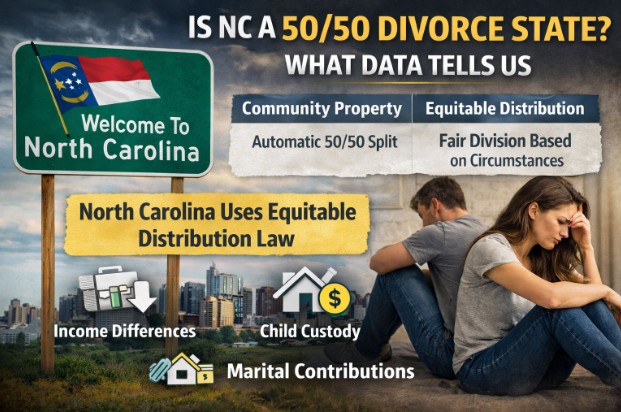
North Carolina is not a strict 50/50 divorce state. North Carolina courts divide marital property under equitable distribution law, which presumes equal division is fair but allows judges to order unequal distribution when fairness requires it.
North Carolina divorce law actually uses equitable distribution, a legal framework that divides marital property fairly rather than automatically dividing everything 50/50.
Spouses beginning a separation frequently review the North Carolina divorce process to understand how courts classify marital assets, calculate net property value, and distribute property under North Carolina’s equitable distribution law.
L. Hudspeth Family Law helps North Carolina spouses understand equitable distribution and property division. Schedule a confidential consultation to discuss your divorce rights and financial protection options.
Equitable distribution is the North Carolina legal process used to divide marital property and debt between spouses during divorce.
North Carolina courts divide marital property according to North Carolina General Statute §50-20.
The statute creates a presumption that equal division of marital property is equitable unless evidence shows an unequal division would be fairer.
| Property System | Rule |
| Community Property | Assets automatically split 50/50 |
| Equitable Distribution | Assets are divided fairly based on the case circumstances |
North Carolina uses equitable distribution rather than the community property rules used in states like California or Texas.
If you’re ready to get started, call us now!
North Carolina courts divide property through a structured three-step process that classifies assets, determines value, and distributes marital property between spouses.
North Carolina District Courts handle equitable distribution claims during divorce cases. Courts must classify property, determine asset values, and distribute marital property equitably between spouses. (nclamp.gov)
| Property Category | Description |
| Marital property | Assets acquired during the marriage before separation |
| Separate property | Property owned before marriage or received through inheritance or gifts |
| Divisible property | Changes in marital asset value occurring after separation |
North Carolina law defines marital property as property acquired during the marriage before separation.
Spouses often review equitable distribution in North Carolina divorces to understand how courts classify assets before dividing marital property.

North Carolina sometimes appears to be a 50/50 divorce state because the law begins with a presumption that equal division of marital property is fair.
North Carolina’s equitable distribution law presumes equal division is equitable unless the court determines that equal division would not be fair.
| Scenario | Likely Outcome |
| Both spouses earn similar income | Equal division often remains |
| Both spouses contributed financially | Equal division common |
| Balanced marital assets | Equal division likely |
Courts retain discretion to depart from equal division when statutory factors support unequal distribution.
Many people misunderstand equitable distribution. North Carolina law does not require equal property division in every divorce.
North Carolina courts start with equal division as a baseline, but may adjust the split if evidence shows unequal division would be more equitable.
Judges may award more property to one spouse when financial circumstances justify unequal distribution.
Property division can significantly affect your financial future. L. Hudspeth Family Law provides experienced guidance on equitable distribution, asset valuation, and divorce mediation across North Carolina. Contact us now.
If you’re ready to get started, call us now!
North Carolina judges evaluate statutory factors when determining whether marital property should be divided equally or unequally.
North Carolina law lists numerous factors courts must consider when distributing marital assets and debts.
| Factor | Example |
| Income disparity | One spouse earns significantly more |
| Length of marriage | Long marriages may justify equal division |
| Child custody needs | The custodial parent may retain the family home |
| Financial contributions | One spouse supported the other’s career |
| Age and health | One spouse has greater financial needs |
Courts may also consider tax consequences, retirement expectations, and financial misconduct affecting marital assets.
Equitable distribution allows North Carolina courts to tailor property division outcomes based on each marriage’s financial circumstances.
Divorce outcomes vary widely depending on marital roles, financial contributions, and childcare arrangements.
| Divorce Scenario | Possible Outcome |
| Dual-income marriage | Equal division likely |
| Stay-at-home parent | Unequal distribution possible |
| Family business ownership | Business awarded with a financial offset |
| Significant income disparity | Larger share awarded to lower-earning spouse |
Courts may order a distributive award, a payment intended to balance unequal asset division when necessary.
Many North Carolina divorces still result in equal property division because courts begin with the presumption that equal division is fair.
North Carolina’s equitable distribution law assumes equal division is equitable unless the court finds evidence that equal division would be unfair.
| Outcome Type | Frequency Trend |
| Equal division | Common in balanced marriages |
| Unequal division | Occurs when statutory factors justify adjustment |
| Settlement agreements | Increasingly common through mediation |
Couples seeking negotiated outcomes often explore family law mediation in North Carolina to resolve property division disputes without trial.
Spouses preparing for equitable distribution should gather financial documentation and identify all marital assets and debts before filing a claim.
Courts require detailed financial disclosures when determining equitable distribution outcomes.
Individuals navigating equitable distribution disputes often consult a family law attorney in Jacksonville, NC, to evaluate property division strategies.
Unsure how North Carolina courts may divide your marital assets? Contact L. Hudspeth Family Law today for trusted legal guidance on divorce, property division, and equitable distribution.
If you’re ready to get started, call us now!
North Carolina is not a community property state. North Carolina uses equitable distribution law to divide marital property fairly between spouses rather than automatically splitting marital assets equally during divorce proceedings.
North Carolina law presumes that an equal division of marital property is fair. Still, judges may order an unequal distribution when statutory factors such as income differences, financial contributions, or childcare responsibilities justify a different result.
North Carolina courts divide marital property and divisible property acquired during the marriage before separation. Marital assets can include real estate, retirement accounts, vehicles, investments, and other financial resources accumulated during the marriage.
Separate property generally remains with the original owner. Separate property includes assets owned before marriage and property received through inheritance or gifts unless those assets were commingled with marital property during the marriage.
Yes. North Carolina courts may award unequal distribution of marital property when statutory factors such as income disparity, childcare responsibilities, health conditions, or financial contributions make equal division unfair under equitable distribution law.
North Carolina courts divide marital debt along with marital assets during equitable distribution proceedings. Judges assign responsibility for credit cards, loans, and other financial obligations based on fairness and each spouse’s financial circumstances.
North Carolina courts typically determine the value of marital property using the date of separation. Courts review financial records, appraisals, and expert testimony to establish accurate valuations before distributing marital assets.
Retirement benefits earned during the marriage are often classified as marital property and may be divided between spouses during equitable distribution. Courts may use qualified domestic relations orders to divide certain retirement accounts.
Yes. Spouses may negotiate property division agreements outside of court if both parties settle. Courts generally approve negotiated agreements if the terms are fair and comply with North Carolina’s equitable distribution law.
North Carolina District Courts handle equitable distribution claims during divorce proceedings. District Court judges review financial evidence, apply statutory factors, and issue orders dividing marital property and marital debt between spouses.
North Carolina is an equitable distribution state. North Carolina courts divide marital property fairly between spouses under equitable distribution rules rather than under community property laws that require an automatic 50/50 division.
Office

Links