


Military divorce in North Carolina requires one year of separation under N.C. Gen. Stat. § 50-6 and six months of residency or stationing under N.C. Gen. Stat. § 50-18. Two federal laws add requirements: the Servicemembers Civil Relief Act and the Uniformed Services Former Spouses’ Protection Act.
Service members stationed at Camp Lejeune can file in Onslow County Superior Court if they meet the six-month threshold, even without changing their state of legal domicile.
Deployment, pension division, and custody during reassignment create layers that civilian divorce does not involve.
Facing a military divorce near Camp Lejeune? N. Lawrence Hudspeth III has guided Onslow County military families through divorce proceedings for over three decades — contact us today.
Military divorce in North Carolina follows the same one-year separation requirement as civilian divorce under N.C.G.S. § 50-6, but federal protections and military-specific rules for pensions, benefits, and deployment add procedural steps that do not apply to civilian cases.
Filing begins in the county where one spouse resides or where the service member holds station.
North Carolina operates as a no-fault divorce state. Neither spouse must prove marital misconduct to obtain an absolute divorce. The sole practical ground requires that both spouses live separate and apart for one continuous year with the intent that the separation remain permanent.
No court filing occurs during that year — the complaint is filed with the Onslow County Clerk of Superior Court after the full 12 months have passed.
Military divorce layers two federal statutes on top of state procedure. The Servicemembers Civil Relief Act (SCRA), codified at 50 U.S.C. §§ 3901–4043, governs procedural protections for active-duty service members.
The Uniformed Services Former Spouses’ Protection Act (USFSPA), codified at 10 U.S.C. § 1408, controls how courts divide military retired pay. Both statutes interact with North Carolina’s equitable distribution framework, which divides marital property based on fairness rather than a 50/50 split.
The practical timeline for a military divorce in Onslow County ranges from four to six months after filing for an uncontested case, and 12 to 18 months, or longer, for contested matters involving pension division, alimony, or child custody disputes.
| Step | Military Divorce | Civilian Divorce |
| Separation period | 1 year (N.C.G.S. § 50-6) | 1 year (same statute) |
| Residency requirement | 6 months residing or stationed (N.C.G.S. § 50-18) | 6 months domicile (N.C.G.S. § 50-8) |
| Default judgment protection | SCRA stay available; 90-day minimum | No federal stay right |
| Retirement pay division | USFSPA governs; DFAS enforces qualifying orders | State equitable distribution only |
| Custody during absence | N.C.G.S. § 50-13.2(f) deployment protections | No deployment-specific protections |
| Benefit continuation | TRICARE eligibility under 20/20/20 or 20/20/15 rules | No military benefit continuation |
| Pay garnishment cap | Combined child support and alimony cannot exceed 60% of pay and allowances (15 U.S.C. § 1673(b)) | Standard NC wage garnishment rules |
A service member stationed at Marine Corps Base Camp Lejeune in Jacksonville, North Carolina, can file for divorce in Onslow County Superior Court after six months of continuous stationing, even if the service member claims legal domicile in another state. N.C. Gen. Stat. § 50-18 explicitly recognizes military stationing as equivalent to residency for divorce jurisdiction.
This statute removes a barrier that would otherwise prevent service members from filing locally. Under standard North Carolina residency rules, a person must demonstrate both physical presence and intent to make the state a permanent home.
Section 50-18 eliminates the intent requirement for military personnel who have been stationed in North Carolina for at least six months before filing.
Camp Lejeune families have three jurisdictional options for filing. The service member can file in North Carolina based on stationing.
The service member can file in their state of legal domicile. The non-military spouse can file in any state that meets its own residency rules. Choosing where to file matters because the filing state’s laws govern equitable distribution, child support calculations, and alimony standards.
Filing in Onslow County offers a practical advantage for families already living near Camp Lejeune: proximity to the courthouse, familiarity with local procedures, and access to attorneys who routinely handle military-specific family law matters.
The Onslow County Clerk processes the complaint, summons, and Domestic Civil Action Cover Sheet. The complaint must include a sworn affidavit disclosing whether the opposing spouse serves in the armed forces.
If you’re ready to get started, call us now!
Two federal statutes govern military divorce protections: the Servicemembers Civil Relief Act shields active-duty personnel from default judgments and forced proceedings during service, and the Uniformed Services Former Spouses’ Protection Act allows state courts to divide military retired pay as marital property.
Both statutes override conflicting state procedures.
Navigating an Onslow County military divorce while a spouse deploys or faces PCS orders? Hudspeth Family Law has protected service members’ rights in custody hearings and pension disputes for over 35 years — schedule a consultation.
The SCRA prevents courts from entering default judgments against service members who cannot appear due to military duty. When a service member receives divorce papers during deployment or training, the SCRA guarantees a minimum 90-day stay of proceedings upon request, so the service member can prepare a response without sacrificing mission duties.
Courts may grant additional stays if the service member demonstrates that military duties materially affect participation.
The SCRA requires the filing spouse to submit an affidavit to the court stating whether the opposing party currently serves in the military. If the opposing party serves on active duty and has not responded, the court must appoint an attorney to represent the absent service member’s interests before proceeding.
The SCRA’s default-judgment shield applies to Marines stationed at Camp Lejeune, sailors at MCAS Cherry Point, and service members at any installation who face legal proceedings in North Carolina family courts.
The SCRA is not automatic. The service member or an attorney must formally invoke the protections. Failure to request a stay in writing may result in the court proceeding without the service member present.
The USFSPA authorizes North Carolina courts to treat disposable military retired pay as divisible marital property rather than income. The act does not guarantee a former spouse any specific share — it permits division, and the court determines the percentage based on North Carolina’s equitable distribution factors under N.C.G.S. § 50-20.
The Defense Finance and Accounting Service (DFAS) enforces qualifying court orders by sending payments directly to the former spouse. Direct payment through DFAS requires that the marriage overlapped with at least 10 years of creditable military service — the commonly cited “10/10 rule.”
A marriage shorter than 10 years of overlapping service does not prevent the court from awarding a share of retired pay; it only means the service member must make payments directly rather than through DFAS garnishment.
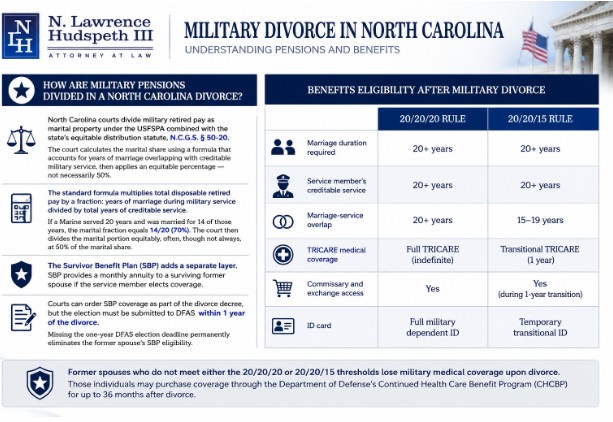
North Carolina courts divide military retired pay as marital property under the USFSPA combined with the state’s equitable distribution statute, N.C.G.S. § 50-20. The court calculates the marital share using a formula that accounts for years of marriage overlapping with creditable military service, then applies an equitable percentage — not necessarily 50%.
The standard formula multiplies total disposable retired pay by a fraction: years of marriage during military service divided by total years of creditable service.
If a Marine served 20 years and was married for 14 of those years, the marital fraction equals 14/20 (70%). The court then divides the marital portion equitably, often, though not always, at 50% of the marital share.
The Survivor Benefit Plan (SBP) adds a separate layer. SBP provides a monthly annuity to a surviving former spouse if the service member elects coverage.
Courts can order SBP coverage as part of the divorce decree, but the election must be submitted to DFAS within 1 year of the divorce. Missing the one-year DFAS election deadline permanently eliminates the former spouse’s SBP eligibility.
| Benefits Eligibility After Military Divorce | 20/20/20 Rule | 20/20/15 Rule |
| Marriage duration required | 20+ years | 20+ years |
| Service member’s creditable service | 20+ years | 20+ years |
| Marriage-service overlap | 20+ years | 15–19 years |
| TRICARE medical coverage | Full TRICARE (indefinite) | Transitional TRICARE (1 year) |
| Commissary and exchange access | Yes | Yes (during 1-year transition) |
| ID card | Full military dependent ID | Temporary transitional ID |
Former spouses who do not meet either the 20/20/20 or 20/20/15 thresholds lose military medical coverage upon divorce. Those individuals may purchase coverage through the Department of Defense’s Continued Health Care Benefit Program (CHCBP) for up to 36 months after divorce.
If you’re ready to get started, call us now!
North Carolina law under N.C.G.S. § 50-13.2(f) prohibits courts from treating a parent’s military deployment as a permanent change of circumstances for custody modification purposes.
A deploying parent retains the right to return to the pre-deployment custody arrangement once the deployment ends, and courts cannot use absence alone to permanently shift primary custody.
Deployed parents in North Carolina can delegate visitation time to a designated family member — typically a grandparent, stepparent, or sibling — during the deployment period. The delegation requires a court order, and the designated person must have a pre-existing, positive relationship with the child.
Onslow County family courts generally support delegation motions when filed in advance of deployment.
A family care plan, required by military regulation for all single parents and dual-military couples, addresses short-term and long-term custody arrangements during deployment.
This document does not replace a court order but demonstrates to the court that the service member planned responsibly. Filing a custody modification before receiving deployment orders — rather than after — provides the strongest legal protection.
The SCRA also applies to custody proceedings. If a service member receives custody modification papers during deployment, the 90-day stay applies. North Carolina courts at Camp Lejeune routinely encounter deployment-related custody motions and apply both state and federal protections in coordination.
Military families approaching divorce frequently rely on informal advice from fellow service members, family readiness groups, or internet forums. Five persistent misconceptions create confusion and lead to preventable legal mistakes in Onslow County and throughout North Carolina.
North Carolina does not have a distinct “military divorce” court or procedure. Military divorces proceed through the same Onslow County Superior Court as civilian divorces. Federal laws add protections and rules on top of state law — they do not replace the state process.
The USFSPA permits division but does not mandate it. North Carolina’s equitable distribution standard considers 12 statutory factors under N.C.G.S. § 50-20(c), including length of marriage, each spouse’s earning capacity, and contributions to the other spouse’s career. Courts may award more or less than 50% of the marital share depending on the circumstances.
The 10/10 rule applies only to DFAS direct payment enforcement. A North Carolina court can still order division of military retired pay for marriages shorter than 10 years of overlapping service — the service member simply pays the former spouse directly.
Service members can be served with the process during deployment. The SCRA allows the service member to request a stay — it does not prevent filing or service. Ignoring divorce papers during deployment risks a default judgment if the service member fails to invoke SCRA protections in writing.
Misconception: Filing in the service member’s domicile state always produces a better outcome.
Jurisdiction selection depends on each state’s property division laws, child support guidelines, and alimony standards. North Carolina’s equitable distribution framework, combined with local courts’ familiarity with military-specific issues, often benefits Camp Lejeune families who file locally.
An uncontested military divorce in Onslow County generally ranges from $3,000 to $7,000 in attorney fees based on 2026 Onslow County estimates, while contested cases involving pension division, custody disputes, or alimony claims can range from $10,000 to $25,000 or more based on 2026 Onslow County estimates. Court filing fees in Onslow County Superior Court run approximately $225 as of 2026 for the initial complaint.
Attorney fee structures in Jacksonville generally follow hourly billing at $200 to $350 per hour as of 2026, though some attorneys offer flat-fee arrangements for uncontested cases.
The total cost depends on whether the case is contested, whether the Military Pension Division requires a Military Pension Division Order, and whether custody disputes require an evaluation or expert testimony.
Military legal assistance offices at Camp Lejeune can provide initial guidance and document review at no cost, but they cannot represent either spouse in court. Legal assistance attorneys help service members understand their rights, review separation agreements, and explain how federal protections apply.
Representation in contested proceedings requires a private civilian attorney who handles military family law in Onslow County.
Mediation can reduce costs significantly. North Carolina courts often refer contested custody and property disputes to mediation before trial.
Camp Lejeune families who reach an agreement through family financial mediation avoid the expense of protracted litigation, and the resulting mediated settlement agreement carries the same enforceability as a court order.
If you’re ready to get started, call us now!
Does North Carolina Require a Separation Period Before Military Divorce?
North Carolina requires a continuous year of separation before either spouse may file for absolute divorce under N.C.G.S. § 50-6. Military status does not waive or shorten the requirement. The one-year clock begins when both spouses establish separate residences with the intent of permanent separation.
Can a Military Spouse File for Divorce in North Carolina if Stationed Out of State?
A military spouse who resided in North Carolina for 6 months remains eligible to file if the civilian spouse still lives in the state. N.C.G.S. § 50-18 ties residency to stationing rather than physical presence, so a PCS transfer does not eliminate jurisdiction.
What Happens to TRICARE Coverage After a Military Divorce?
TRICARE eligibility depends on the length of marriage relative to military service. Former spouses who meet the 20/20/20 rule retain full TRICARE coverage indefinitely. The 20/20/15 rule provides one year of transitional coverage. Former spouses meeting neither threshold may purchase CHCBP for up to 36 months after divorce.
How Does Deployment Affect the One-Year Separation Requirement in North Carolina?
Deployment does not pause or extend the one-year separation clock. The year continues running while the service member serves overseas if both spouses established separate residences beforehand. Physical separation from military orders alone does not satisfy the requirement without a mutual intent to permanently separate.
Can a Court Change Custody Permanently Because a Parent Deployed?
North Carolina law, under N.C.G.S. § 50-13.2(f), explicitly prevents courts from treating a parent’s absence due to military deployment as grounds for a permanent custody modification. Temporary modifications may occur during deployment, but the pre-deployment arrangement resumes when the parent returns from duty.
Does the Military Require Service Members to Financially Support a Spouse During Separation?
Military regulations require service members to provide interim financial support to dependents during separation. Each branch maintains specific guidelines — the Marine Corps references MARCORSEPMAN Chapter 15. Branch-level support rules operate independently from North Carolina court-ordered support and set minimums based on rank.
What Is the Difference Between Domicile and Residency for Military Divorce in North Carolina?
Domicile requires physical presence and intent to make North Carolina a permanent home. N.C.G.S. § 50-18 requires only six months of stationing at a North Carolina installation. A Marine at Camp Lejeune claiming Texas domicile qualifies to file in Onslow County.
Can JAG Lawyers Represent Service Members in Divorce Court?
Judge Advocate General attorneys at Camp Lejeune provide legal assistance — document review, rights explanations, and procedural guidance — but do not represent either spouse in divorce proceedings. Representation in Onslow County Superior Court requires a private civilian attorney licensed in North Carolina.
How Does a Military Pension Division Order Get Enforced After Divorce?
The divorce decree or separate court order must meet DFAS formatting requirements for direct payment under 10 U.S.C. § 1408. DFAS reviews the order and sends payments directly to the former spouse if the 10/10 overlap threshold applies. Non-compliant orders require amendment and resubmission.
What Role Does Onslow County Play in Military Divorce Proceedings?
Onslow County Superior Court serves as the primary venue for military divorces filed by Camp Lejeune families. The Jacksonville courthouse processes complaints, summons, and ancillary claims, including equitable distribution, alimony, and custody. Onslow County judges routinely handle SCRA motions and pension division orders.
Your military service should not leave you unprotected in a divorce. Hudspeth Family Law has served Camp Lejeune Marines, sailors, and military families in Onslow County for over 35 years — call today to discuss your case.
Office

Links