

North Carolina spouses do not need a separation agreement to become legally separated or to file for divorce.
Living apart with the intent that the separation be permanent creates a legal separation under North Carolina law — not a signed document.
A separation agreement is instead a voluntary written contract, authorized under North Carolina General Statutes § 52-10.1, that spouses use to set property and support terms; provisions touching a minor child remain subject to the court’s independent oversight. Without an agreement, courts decide these issues later through litigation.
N. Lawrence Hudspeth III advises Onslow County spouses on separation agreement terms, whether through direct representation or family financial mediation.
No North Carolina statute requires a separation agreement before a couple can be considered legally separated.
Legal separation occurs the moment spouses move into separate residences with at least one spouse intending the separation to be permanent, according to the North Carolina Judicial Branch. No paperwork or court filing creates or confirms this status.
That one-year separation period is also what qualifies spouses for an absolute divorce under North Carolina law.
A separation agreement runs alongside that process rather than replacing it — it resolves the financial and parenting issues that arise during the year of separation, while the separation itself is established by conduct, not contract.
If you’re ready to get started, call us now!
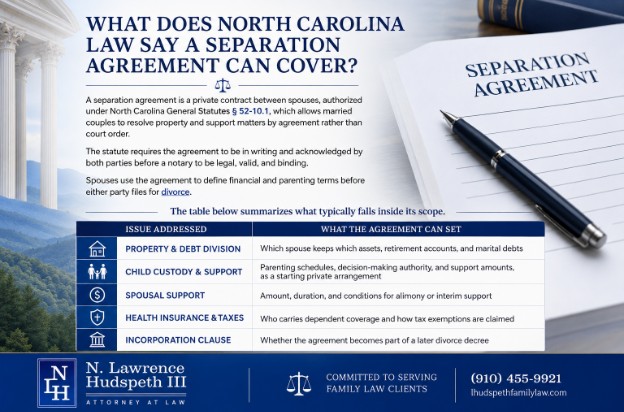
A separation agreement is a private contract between spouses, authorized under North Carolina General Statutes § 52-10.1, which allows married couples to resolve property and support matters by agreement rather than court order.
The statute requires the agreement to be in writing and acknowledged by both parties before a notary to be legal, valid, and binding.
Spouses use the agreement to define financial and parenting terms before either party files for divorce. The table below summarizes what typically falls inside its scope.
| Issue Addressed | What the Agreement Can Set |
| Property & debt division | Which spouse keeps which assets, retirement accounts, and marital debts |
| Child custody & support | Parenting schedules, decision-making authority, and support amounts, as a starting private arrangement |
| Spousal support | Amount, duration, and conditions for alimony or interim support |
| Health insurance & taxes | Who carries dependent coverage and how tax exemptions are claimed |
| Incorporation clause | Whether the agreement becomes part of a later divorce decree |
Custody and child support terms written into an agreement operate as a private arrangement between the spouses, but two separate statutes limit how final that arrangement is.
North Carolina General Statutes § 50-13.4 allows either parent to bring a separate civil action for child support regardless of what a private agreement states, and North Carolina General Statutes § 50-13.2 requires any custody order to reflect the child’s best interest without a presumption favoring either parent’s agreement.
If a court later enters a support or custody order, it can be modified on a showing of changed circumstances under North Carolina General Statutes § 50-13.7.
Terms involving equitable distribution and child custody can each be addressed within a single agreement or handled as separate documents, depending on the couple’s circumstances.
Couples who split on good terms often assume a written agreement isn’t necessary, but memory and goodwill fade as the one-year separation period stretches on.
A separation agreement puts the property and support terms both spouses agreed to at the time of separation into a written contract, so later disagreements over those terms don’t have to be resolved from scratch.
As a private contract, the agreement generally binds the spouses on property and spousal-support terms, subject to the same contract defenses—such as duress or incomplete disclosure—that can affect any signed agreement.
Custody and child support terms in the same document remain open to court review under the standards described above.
Without an agreement, financial and parenting terms remain undecided and exposed to change. If one spouse later disputes an informal understanding, the other spouse has no written document to point to, and the matter may require litigation to resolve — even between people who never intended to fight in court.
Resolving terms by agreement generally costs less and takes less time than resolving the same terms through contested litigation.
A separation agreement also creates a paper record. According to the North Carolina Judicial Branch, a spouse’s truthful testimony can prove separation to the court, and a separation agreement between spouses can help support that testimony when a divorce is later filed.
A properly executed separation agreement is legally binding and enforceable as a contract under North Carolina General Statutes § 52-10.1. To meet that standard, the agreement must be in writing, signed by both spouses, and acknowledged before a notary public.
Enforcement mechanisms depend on the nature of each provision and whether the agreement was incorporated into a later divorce decree.
Incorporation generally opens the door to the court’s contempt powers to enforce the order, while specific remedies—such as wage withholding or a judgment lien—depend on the type of obligation and how the underlying order is structured.
An agreement left unincorporated remains a private contract; enforcing it typically requires a separate breach-of-contract action against the noncompliant spouse.
Because these remedies vary by provision and procedural posture, an attorney should confirm which enforcement path applies to a specific agreement.
Signing without independent legal advice does not automatically invalidate a separation agreement, but a court may weigh it if the agreement is later challenged.
If you’re ready to get started, call us now!
Onslow County’s proximity to Camp Lejeune means many separation agreements involve at least one active-duty spouse, and federal law overrides certain terms that a state contract cannot control.
The North Carolina State Bar’s Legal Assistance for Military Personnel program confirms that Servicemembers’ Group Life Insurance beneficiary designations are governed exclusively by federal statute, not by state contract or court order.
| Benefit | Can a Separation Agreement Control It? | Why |
| SGLI beneficiary | No | Ridgway v. Ridgway, 454 U.S. 46 (1981) gives beneficiary authority solely to the service member |
| Tricare eligibility | No | Governed by 10 U.S.C. § 1072; a former spouse’s continued eligibility depends on marriage length and service overlap under the 20/20/20 or 20/20/15 rules |
| Basic Allowance for Housing (BAH) | Indirectly | The military sets the rate and eligibility rules by branch; the agreement can address reimbursement or interim support between spouses |
| Military retirement pay | Yes, within limits | Federal law (10 U.S.C. § 1408, the Uniformed Services Former Spouses’ Protection Act) authorizes state courts to treat military retired pay as divisible property; North Carolina’s equitable distribution law then governs how it’s divided, and a share must be specifically awarded in the decree or agreement to be enforceable |
Because SGLI cannot be locked in by contract, spouses relying on life insurance as security for a settlement are generally better served by a private policy instead — a point the Judge’s Guide to Military Divorce in North Carolina raises for this reason.
Tricare eligibility after divorce is similarly fixed by federal rule rather than by agreement; the North Carolina State Bar’s primer on former-spouse medical benefits explains the specific marriage-length and service-overlap requirements that determine it.
A separation agreement is not the same as legal separation, and confusing the two is one of the most common misconceptions spouses bring into a first consultation. Legal separation is a factual status created by living apart with intent to remain apart — it requires no document at all.
A separation agreement is an optional written contract that spouses may choose to sign once separated.
The timing of when a separation agreement can be signed relative to physical separation involves technical requirements under North Carolina law that vary by circumstance; spouses should confirm the applicable timing with an attorney before executing an agreement.
The two concepts run on separate tracks: legal separation describes a living situation, while a separation agreement describes a financial and parenting contract.
Reviewing separation terms before signing helps prevent later disputes.
N. Lawrence Hudspeth III negotiates separation terms for Onslow County spouses through mediation or direct representation, depending on what fits the case. Contact the office to discuss next steps.
A separation agreement becomes a binding contract the moment both spouses sign and acknowledge it before a notary, so reviewing it before signing matters more than reviewing it after.
An attorney can confirm that financial disclosures are complete, that support terms meet North Carolina’s legal standards, and that military-specific clauses account for federal limitations like SGLI and Tricare.
Spouses considering family financial mediation rather than a fully litigated settlement can often resolve these terms without appearing in court, while spouses facing an uncooperative party or inadequate financial disclosure may need the enforcement tools that come with a formal court process instead.
If you’re ready to get started, call us now!
Do spouses need a separation agreement to get divorced in North Carolina?
No. North Carolina requires only that spouses live separate and apart for one year with intent to remain separated. A separation agreement is optional and resolves property, support, and custody terms, but it is not a legal prerequisite for filing for divorce.
What happens if spouses separate without a separation agreement?
Without an agreement, financial and parenting terms remain undecided. Either spouse can later ask a court to resolve property division, custody, or support through litigation, which generally adds cost and takes longer than resolving terms by agreement beforehand.
Can a separation agreement be changed after it’s signed?
Property and spousal-support terms can be amended by mutual written consent. Custody and child support terms remain subject to the court’s independent authority — under North Carolina General Statutes § 50-13.4 for support and § 50-13.7 for modifying an existing order — regardless of what the parents originally agreed.
Does a North Carolina separation agreement need to be notarized?
Yes. North Carolina General Statutes § 52-10.1 requires the agreement to be in writing and acknowledged by both spouses before a notary public. An unnotarized agreement is not legally valid or enforceable as a separation contract.
Can spouses write their own separation agreement without an attorney?
Spouses can draft their own agreement, but errors in financial disclosure, support calculations, or enforceability language can make the document difficult to enforce later. Legal review before signing helps confirm the agreement meets North Carolina’s requirements and addresses each spouse’s interests.
What if one spouse refuses to sign a separation agreement?
A spouse cannot be forced to sign a separation agreement. If one spouse refuses, remaining options include further negotiation or mediation, and certain claims — such as post-separation support under North Carolina General Statutes § 50-16.2A — may be available in court without waiting for the full one-year separation period to pass.
Does a separation agreement control military benefits like SGLI or Tricare?
No. Federal law, not the separation agreement, governs SGLI beneficiary designations and Tricare eligibility. Spouses relying on life insurance as security for a settlement typically need a private policy, since SGLI beneficiary rights belong solely to the service member.
Is a separation agreement the same thing as legal separation?
No. Legal separation is a factual status created by living apart with intent to remain separated — no document is required. A separation agreement is an optional written contract addressing property and support terms, and a couple can be legally separated without ever signing one.
Can a separation agreement be incorporated into a divorce decree?
Yes, if both spouses agree. Incorporation generally makes the agreement’s terms enforceable through the court’s contempt powers, with the specific remedy depending on the provision involved. Spouses who prefer the agreement to remain a private contract can include a clause barring incorporation.
How long does a North Carolina separation agreement stay in effect?
An unincorporated separation agreement remains in effect indefinitely as a private contract for its property and support terms, unless the spouses amend it. If incorporated into a divorce decree, its terms become part of the court order; custody and child support terms remain subject to modification under North Carolina General Statutes § 50-13.7 regardless of incorporation.
A separation agreement is optional in North Carolina — legal separation happens by living apart, not by signing a document. Spouses use the agreement instead to put property and support terms into a written contract under North Carolina General Statutes § 52-10.1.
Custody and child support terms remain subject to the court’s independent oversight — under North Carolina General Statutes §§ 50-13.2 and 50-13.4 regardless of what the agreement states, and under § 50-13.7 if a court order is later modified.
Military families need to account for federal limits on benefits like SGLI and Tricare that a state agreement cannot override, and confirm how military retirement is divided under the Uniformed Services Former Spouses’ Protection Act.
Before signing, a spouse benefits from confirming that financial disclosure is complete, that support terms meet North Carolina’s standards, and that any military-specific provisions are accurately drafted — points an attorney can verify in a single review before the agreement becomes binding.
N. Lawrence Hudspeth III has represented military and civilian families across Onslow County for more than 45 years. Schedule a consultation to review a separation agreement’s terms before signing.
Office

Links