


The 10/10 rule governs whether the Defense Finance and Accounting Service processes direct payments to a former spouse, not whether a former spouse has a right to a share of military retired pay.
The rule, codified at 10 U.S.C. § 1408(d)(2), requires at least 10 years of marriage overlapping with at least 10 years of the service member’s creditable military service before DFAS sends the former spouse’s awarded share directly.
North Carolina courts retain full authority to divide military retired pay as marital property under N.C. Gen. Stat. § 50-20 regardless of whether the marriage meets the 10/10 threshold, because the USFSPA at 10 U.S.C. § 1408 grants equitable distribution power to state courts without imposing a minimum marriage length.
Confused about whether the 10/10 rule applies to your Camp Lejeune divorce? Hudspeth Family Law has handled military pension division in Onslow County for over three decades — contact us today.
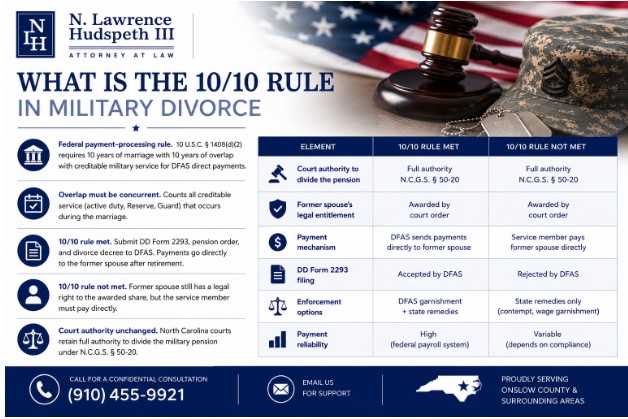
The 10/10 rule is a federal payment-processing requirement — not an entitlement rule — codified at 10 U.S.C. § 1408(d)(2) within the Uniformed Services Former Spouses’ Protection Act (USFSPA). DFAS will process direct payments to a former spouse only when the marriage lasted at least 10 years and at least 10 of those years overlapped with the service member’s creditable military service.
The overlap must be concurrent. A 12-year marriage to a service member who served eight of those years on active duty produces only eight years of overlap — below the 10-year threshold. The overlap calculation counts all creditable military service, whether active duty, Reserve, or Guard, as long as the service years run concurrently with the marriage years.
When the 10/10 threshold is met, the former spouse submits DD Form 2293, a certified copy of the military pension division order, and the divorce judgment to DFAS at P.O. Box 998002, Cleveland, OH 44199-8002.
DFAS then pays the awarded share directly to the former spouse each month upon the service member’s retirement, eliminating the service member as a payment intermediary.
When the 10/10 threshold is not met, the former spouse still holds a legal right to the awarded share of military retired pay under state law. The service member must pay the former spouse directly from personal funds after receiving retired pay. DFAS simply declines to act as the payment processor.
| Element | 10/10 Rule Met | 10/10 Rule Not Met |
| The court has the authority to divide the pension | Full — N.C.G.S. § 50-20 | Full — N.C.G.S. § 50-20 (unchanged) |
| Former spouse’s legal entitlement | Awarded by court order | Awarded by court order (unchanged) |
| Payment mechanism | DFAS sends payments directly to the former spouse | Service member pays former spouse from personal funds |
| DD Form 2293 filing | Accepted by DFAS | Rejected by DFAS |
| Enforcement options | DFAS garnishment + state remedies | State remedies only (contempt, wage garnishment) |
| Payment reliability | High — federal payroll system | Variable — depends on service member compliance |
The 10/10 rule does not determine whether a former spouse receives a share of military retired pay. The rule determines only whether DFAS processes the payment. North Carolina courts award pension division under N.C.G.S. § 50-20 and the USFSPA at 10 U.S.C. § 1408 without regard to marriage length, because federal law grants state courts division authority based on jurisdictional requirements at § 1408(c)(4) — not based on the duration of the marriage.
A Camp Lejeune Marine married for six years who divorces after six years of overlapping service produces zero 10/10 eligibility.
The Onslow County court can still order equitable distribution of the marital pension share earned during those six years. The court calculates the marital fraction, applies an equitable percentage under § 50-20(c), and enters the division in the divorce decree.
The only difference between a six-year marriage and a 12-year marriage for pension purposes: who writes the check.
The misconception that “no 10/10 means no pension” persists in barracks conversations, family readiness group briefings, and internet forums. Former spouses who accept this false premise walk away from retirement benefits they legally hold under North Carolina law.
Service members who rely on this misconception risk contempt proceedings when a court orders pension division despite the absence of DFAS direct payment eligibility.
The NC State Bar’s Legal Assistance for Military Personnel committee addresses this misconception directly in the USFSPA FAQ published through the LAMP program, confirming that North Carolina courts divide military retired pay for marriages of any length that meet jurisdictional requirements.
If you’re ready to get started, call us now!
DFAS acts as a federal payment agent — not a court, not an arbiter, and not an enforcement body. When the 10/10 overlap threshold is satisfied, DFAS accepts a qualifying court order and processes monthly payments directly to the former spouse once the service member begins receiving retired pay.
The former spouse initiates direct payment by filing DD Form 2293 with DFAS, along with a certified copy of the pension division order and the divorce judgment. The Onslow County Clerk of Superior Court must certify the order within 90 days of service on DFAS.
DFAS reviews the order for compliance with DoDFMR Volume 7B, Chapter 29, and either approves or rejects it based on formatting requirements — not on the merits of the underlying divorce.
DFAS direct payment carries three operational advantages. DFAS deducts the former spouse’s share before the service member receives retired pay, eliminating late or missed payments.
DFAS issues separate IRS Form 1099-R statements to each party, ensuring that the former spouse pays taxes only on the share received. DFAS processes payments on the federal payroll schedule, providing monthly predictability that private enforcement cannot match.
Federal law caps DFAS direct payment at 50% of the service member’s disposable retired pay for property division under 10 U.S.C. § 1408(e)(1). The cap rises to 65% when the order combines property division with alimony or child support.
DFAS pays only prospective payments — monthly installments as they become due after the service member retires. DFAS does not pay retroactive arrears under DoDFMR Volume 7B, Chapter 29, Section 290304.
Courts that order retroactive pension payments must enforce collection through separate state-level mechanisms.
Marriages that fall short of the 10/10 overlap do not lose the right to a division of the pension — the Onslow County court retains full authority to divide military retired pay under N.C.G.S. § 50-20.
The practical consequence of missing the 10/10 threshold is that the payment obligation shifts from DFAS to the service member, introducing an enforcement risk that the pension division order must address.
A service member ordered to pay a former spouse’s pension share directly may comply voluntarily. When compliance fails, North Carolina law provides enforcement tools: contempt of court proceedings, wage garnishment through the service member’s civilian or military employer, interception of state income tax refunds, and suspension of the driver’s license.
Attorneys drafting pension division orders for sub-10/10 marriages should build three enforcement protections into the order.
The order should include a specific dollar amount or percentage tied to the marital fraction and equitable distribution ruling. The order should contain an automatic wage garnishment provision that takes effect upon a missed payment.
The order should include an attorney fee provision awarding fees to the former spouse for enforcement proceedings triggered by nonpayment, so the former spouse avoids absorbing legal costs that result from the service member’s failure to comply.
Family financial mediation can resolve sub-10/10 pension disputes before trial by producing a detailed payment schedule with built-in enforcement language. Mediated agreements are as enforceable as contested court orders once the Onslow County court approves the consent judgment.
Misunderstanding the 10/10 rule can cost Camp Lejeune families years of retirement income. Hudspeth Family Law drafts pension division orders that protect your share regardless of the length of your marriage — schedule a consultation.
The 10/10 rule and the frozen benefit rule operate on different elements of the same pension division. The 10/10 rule at 10 U.S.C. § 1408(d)(2) governs the payment mechanism — who sends the check. The frozen benefit rule under Section 641 of the FY2017 NDAA governs the calculation base — how much retired pay DFAS divides.
A Camp Lejeune Marine who divorces with 12 years of overlapping service meets the 10/10 threshold, qualifying the former spouse for DFAS direct payment.
The frozen benefit rule then limits the divisible amount to the hypothetical retired pay the Marine would have received at the rank and High-3 pay held on the date of divorce. Post-divorce promotions and additional service years do not increase the amount DFAS divides.
The interaction produces a compounding reduction in the long-service marriages of former spouses. The frozen benefit rule shrinks the divisible base. The expanding denominator in the marital fraction — total creditable service continues growing after divorce — shrinks the former spouse’s proportional share of the already-frozen amount.
The NC State Bar LAMP committee’s Silent Partner series identifies this compound effect as the “denominator dilemma.”
North Carolina courts can address the denominator dilemma by ordering the service member to indemnify the former spouse for the difference between the frozen benefit amount and the actual retired pay at retirement.
Indemnification language must appear in the pension division order or equitable distribution consent order — courts cannot add indemnification provisions after the divorce judgment without a modification motion.
| Rule | What It Controls | Statutory Authority | Effect on Former Spouse |
| 10/10 rule | Payment mechanism (DFAS vs. service member) | 10 U.S.C. § 1408(d)(2) | Determines payment reliability, not entitlement |
| Frozen benefit rule | Calculation base (hypothetical vs. actual retired pay) | Section 641, NDAA FY2017; 10 U.S.C. § 1408(a)(4)(B) | Reduces the divisible amount by freezing the rank and service at the divorce date |
| Combined effect | Payment route + reduced base | Both statutes apply simultaneously | Former spouse receives DFAS payments (if 10/10 met), but from a frozen, shrinking share |
If you’re ready to get started, call us now!
Five misconceptions about the 10/10 rule persist across military installations, legal assistance offices, and online forums. Each misconception costs former spouses’ retirement income or creates false security for service members.
Misconception: A former spouse married less than 10 years gets nothing from the military pension.
The 10/10 rule at 10 U.S.C. § 1408(d)(2) governs DFAS direct payment processing only. North Carolina courts divide military retired pay for marriages of any length under N.C.G.S. § 50-20, provided the court holds jurisdiction under § 1408(c)(4). The service member pays the awarded share directly when DFAS cannot process the payment.
Misconception: The 10/10 rule guarantees a former spouse 50% of military retired pay.
The 10/10 rule sets no percentage and awards no amount. The rule enables payment delivery. North Carolina’s equitable distribution statute determines the actual share, and 50% of the marital portion represents the presumptive starting point — not a guarantee.
Misconception: The 10 years of marriage and 10 years of service can be added separately.
The 10/10 rule requires concurrent overlap. A 15-year marriage with only seven years of overlapping military service does not satisfy the threshold, because the overlap falls three years short of the 10-year minimum.
Misconception: DFAS will enforce the pension division if the service member does not comply.
DFAS processes payments — DFAS does not enforce court orders. When a service member fails to pay the former spouse’s share directly (in sub-10/10 cases), enforcement requires a contempt motion in the Onslow County court that issued the divorce decree.
Misconception: The 10/10 rule applies to TRICARE, commissary, and exchange privileges.
TRICARE eligibility for former spouses follows the 20/20/20 and 20/20/15 rules — separate provisions with different overlap thresholds. The 10/10 rule applies exclusively to the DFAS direct payment of the military pension division and has no bearing on healthcare or installation access benefits.
If you’re ready to get started, call us now!
Does the 10/10 Rule Prevent a North Carolina Court From Dividing Military Retired Pay?
The 10/10 rule does not limit a North Carolina court’s authority to divide military retired pay. N.C.G.S. § 50-20 grants equitable distribution powers regardless of the length of the marriage. The 10/10 rule restricts only the DFAS direct payment mechanism under 10 U.S.C. § 1408(d)(2).
What Counts as Creditable Military Service for the 10/10 Overlap?
Creditable military service includes active duty, Reserve, and Guard time that counts toward retirement eligibility. The overlap calculation measures the number of months of concurrent marriage and creditable service. Non-creditable periods, such as inactive Reserve time without points, do not count.
Can a Former Spouse Request DFAS Direct Payment After the Divorce Is Final?
A former spouse who meets the 10/10 threshold can submit DD Form 2293 to DFAS at any time after the divorce, provided the pension division order meets DoDFMR Volume 7B, Chapter 29 requirements. DFAS begins payments when the service member starts receiving retired pay.
How Does North Carolina Enforce Pension Division When DFAS Cannot Process Payments?
North Carolina enforces pension division orders through contempt of court proceedings, wage garnishment, state income tax refund interception, and driver’s license suspension. Attorneys should draft automatic enforcement triggers directly into the pension division order.
Does the 10/10 Rule Apply to Guard and Reserve Retirement?
The 10/10 rule applies to Guard and Reserve retirement under the same overlap standard. The former spouse must show 10 years of marriage overlapping 10 years of creditable Guard or Reserve service measured in retirement points rather than calendar months.
What Happens if the Marriage Is Nine Years and Eleven Months?
DFAS measures the 10-year overlap strictly. A marriage that falls one month short of 10 years of concurrent service does not qualify for direct payment. The North Carolina court can still divide the pension, but the service member must pay directly.
Can the 10/10 Rule Change Through Federal Legislation?
Congress has considered proposals to eliminate or modify the 10/10 direct payment threshold in several recent NDAA cycles. No amendment has been passed as of June 2026. Any change would require a new statutory provision amending 10 U.S.C. § 1408(d)(2).
Does the 10/10 Rule Affect the Survivor Benefit Plan?
The 10/10 rule does not govern SBP eligibility. The SBP election requires a separate filing with DFAS within one year of divorce. A former spouse in a sub-10/10 marriage can still receive SBP coverage if the service member elects or the court orders coverage.
What Tax Forms Does DFAS Issue When Direct Payment Is Active?
DFAS issues IRS Form 1099-R to each party separately when processing direct payments. The former spouse reports and pays taxes only on the received share. The service member’s 1099-R reflects only the retained portion of retired pay.
Where Can Attorneys Find Drafting Guidance for 10/10 Pension Division Orders?
The Sullivan Silent Partner info-letter series, published by the NC State Bar LAMP Committee and the ABA Family Law Section Military Committee, provides clause-by-clause drafting guidance for military pension division orders, including sub-10/10 enforcement provisions.
Your marriage length does not determine your right to military retirement — only the payment route. Hudspeth Family Law drafts pension division orders that protect Camp Lejeune families regardless of 10/10 status — call today to discuss your case.
Office

Links