


Absolute divorce in North Carolina requires one continuous year of living separate and apart under N.C. Gen. Stat. § 50-6 and six months of state residency under N.C.G.S. § 50-8. Onslow County families must file equitable distribution, alimony, and postseparation support claims before the divorce judgment is entered, or the court permanently waives those rights.
Military families stationed at Camp Lejeune satisfy the residency requirement through six months of stationing under N.C.G.S. § 50-18.
Facing divorce in Onslow County and unsure where to start? Hudspeth Family Law has guided Jacksonville families through separation, property division, and custody for over 35 years — contact us today.
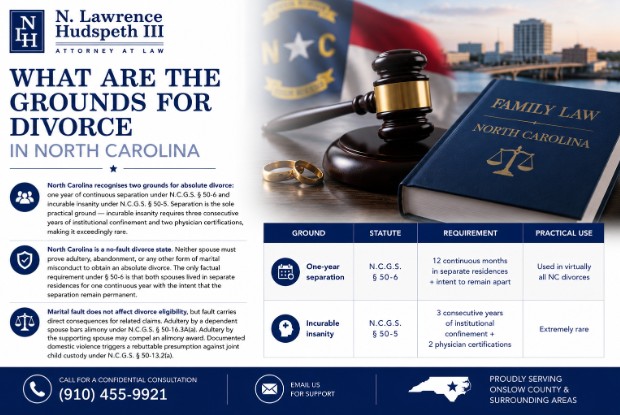
North Carolina recognises two grounds for absolute divorce: one year of continuous separation under N.C.G.S. § 50-6 and incurable insanity under N.C.G.S. § 50-5. Separation is the sole practical ground — incurable insanity requires three consecutive years of institutional confinement and two physician certifications, making it exceedingly rare.
North Carolina is a no-fault divorce state. Neither spouse must prove adultery, abandonment, or any other form of marital misconduct to obtain an absolute divorce.
The only factual requirement under § 50-6 is that the filing spouse demonstrate that both spouses lived in separate residences for one continuous year with the intent that the separation remain permanent.
Marital fault does not affect divorce eligibility, but fault carries direct consequences for related claims. Adultery by a dependent spouse bars alimony under N.C.G.S. § 50-16.3A(a).
Adultery by the supporting spouse may compel an alimony award. Documented domestic violence triggers a rebuttable presumption against joint child custody under N.C.G.S. § 50-13.2(a).
| Ground | Statute | Requirement | Practical Use |
| One-year separation | N.C.G.S. § 50-6 | 12 continuous months in separate residences + intent to remain apart | Used in virtually all NC divorces |
| Incurable insanity | N.C.G.S. § 50-5 | 3 consecutive years of institutional confinement + 2 physician certifications | Extremely rare |
North Carolina requires 12 continuous months of physical separation in different residences before either spouse files for absolute divorce. The one-year clock begins on the date both spouses occupy separate homes, and at least one spouse must intend the separation to remain permanent.
Occupying separate bedrooms within the same house does not satisfy § 50-6. North Carolina case law requires separate residences — physically distinct addresses where each spouse maintains an independent household. A single overnight reunion during the separation period can reset the one-year clock, requiring the full 12 months to restart.
No court filing occurs during the separation year. North Carolina does not require a formal “legal separation” filing to begin the clock. The complaint for absolute divorce goes to the Onslow County Clerk of Superior Court after the full year has passed.
The filing spouse testifies under oath to the separation date at the final hearing — the court does not require independent proof of separation.
At least one spouse must maintain North Carolina residency for six months before filing under N.C.G.S. § 50-8. Military service members stationed at Camp Lejeune satisfy the residency requirement through six months of military stationing under N.C.G.S. § 50-18, even without changing their state of legal domicile.
Divorce from bed and board under N.C.G.S. § 50-7 is a fault-based legal separation, not a dissolution of the marriage. The marital bond remains intact after a bed-and-board order, which means neither spouse may remarry.
The order permits physical separation and triggers property and support rights, but both spouses must still wait the full one-year period under § 50-6 before filing for absolute divorce.
N.C.G.S. § 50-7 requires the filing spouse to prove one of six fault grounds through evidence presented to the Onslow County court.
| Fault Ground Under § 50-7 | Description |
| Abandonment | Spouse left the family without justification |
| Malicious turning out | Spouse forced the other out of the shared residence |
| Cruel or barbarous treatment | Conduct that endangers the other spouse’s life |
| Indignities | Pattern of behaviour rendering cohabitation intolerable |
| Excessive drug or alcohol use | Substance use is making the other spouse’s life unbearable |
| Adultery | Sexual relations outside marriage |
A bed-and-board order directly affects equitable distribution and postseparation support rights. The spouse who obtains the order may request temporary spousal support while the absolute divorce remains pending.
The order can also require one spouse to vacate the marital residence — a critical remedy in cases involving domestic violence or unsafe living conditions.
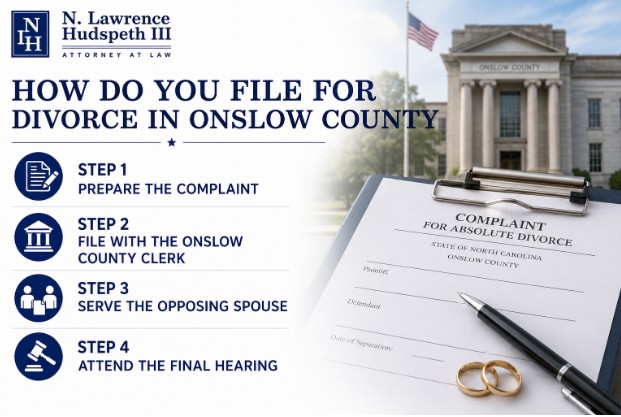
Filing for absolute divorce in Onslow County follows a four-step process: preparing the complaint, filing with the Clerk, serving the opposing spouse, and attending the final hearing.
Step 1 — Prepare the complaint. The filing spouse drafts a Complaint for Absolute Divorce alleging the separation date, a continuous one-year separation, and six months of North Carolina residency. The complaint must include a sworn affidavit disclosing whether the opposing spouse serves in the military, as required by the Servicemembers Civil Relief Act.
Onslow County divorce involves ancillary claims that affect financial and parental rights long after the final judgment. Hudspeth Family Law ensures no claim is waived — schedule a consultation.
Step 2 — File with the Onslow County Clerk. The filing spouse submits the complaint, a summons, and a Domestic Civil Action Cover Sheet to the Onslow County Clerk of Superior Court. Court filing fees run approximately $225 as of 2026. Spouses unable to pay may file a Petition to Proceed as an Indigent.
Step 3 — Serve the opposing spouse. The filing spouse delivers the summons and complaint to the opposing spouse through the Onslow County Sheriff ($30 as of 2026), a private process server ($50–$150 as of 2026), certified mail ($30–$50 as of 2026), or commercial delivery service.
When the opposing spouse’s address is unknown, North Carolina permits service by publication in a newspaper. The opposing spouse must file a written answer within 30 days of service.
Step 4 — Attend the final hearing. Uncontested absolute divorces require a brief hearing where the filing spouse testifies under oath to the separation date, the one-year period, and residency. Contested divorces involving child support, custody, alimony, or equitable distribution require separate hearings, discovery, depositions, and potentially a trial.
North Carolina permanently waives unasserted equitable distribution and alimony claims once the court enters the absolute divorce judgment. Onslow County spouses who fail to file these claims before the judgment lose the right to divide marital property and seek spousal support — a procedural trap that costs families their equitable distribution and alimony rights.
Three categories of claims require pre-judgment filing. Equitable distribution under N.C.G.S. § 50-20 divides marital property and debt. Alimony under N.C.G.S. § 50-16.3A provides spousal support based on need, ability to pay, and marital misconduct.
Postseparation support under N.C.G.S. § 50-16.2A addresses the dependent spouse’s immediate financial needs while the divorce remains pending.
Child custody and child support claims are not subject to the same waiver rule. North Carolina permits custody and support filings at any time — before, during, or after the absolute divorce.
Military families at Camp Lejeune face additional pre-judgment considerations. Military pension division under the USFSPA and Survivor Benefit Plan elections must be addressed in the equitable distribution claim.
Failing to assert pension division before the divorce judgment eliminates the former spouse’s right to a share of military retired pay.
An uncontested absolute divorce in Onslow County typically costs between $2,000 and $5,000 in attorney fees based on 2026 Jacksonville-area estimates. Contested divorces involving equitable distribution, custody, alimony, or military pension division range from $8,000 to $25,000 or more based on 2026 Jacksonville-area estimates.
Court filing fees in Onslow County run approximately $225 as of 2026 for the initial complaint. Service of process fees vary by method and add to the total filing cost.
Mediation reduces costs for contested cases. North Carolina mandates mediation in contested equitable distribution and custody disputes before the Onslow County court schedules a trial.
Family financial mediation produces enforceable consent orders at a fraction of the cost of litigation. Camp Lejeune families who reach an agreement through mediation avoid the expense of protracted court proceedings while maintaining greater control over custody schedules, property division, and support terms.
How Long Does a Divorce Take in Onslow County, North Carolina?
An uncontested absolute divorce takes 30 to 90 days after filing, provided the mandatory one-year separation period has passed. Contested cases involving property division, custody, or alimony typically require 12 to 24 months from the date of filing through final resolution.
Does North Carolina Require Legal Separation Before Divorce?
North Carolina requires one continuous year of physical separation under N.C.G.S. § 50-6 before filing for absolute divorce. The state does not require a formal legal separation filing — the clock begins when both spouses occupy separate residences with the intent to remain apart.
Can I File for Divorce in North Carolina if My Spouse Lives in Another State?
North Carolina allows filing when at least one spouse has maintained six months of state residency under N.C.G.S. § 50-8 before the filing date. The out-of-state spouse must be properly served with the summons and complaint to establish the court’s personal jurisdiction over that spouse.
What Happens to Marital Property if I Do Not File an Equitable Distribution Claim?
North Carolina permanently waives unasserted equitable distribution claims once the Onslow County court enters the absolute divorce judgment under N.C.G.S. § 50-11(e). Filing the equitable distribution claim before the judgment preserves the right to a court-ordered division of all marital property and debt.
Does Adultery Affect Divorce or Property Division in North Carolina?
Adultery does not prevent a North Carolina court from granting an absolute divorce. Adultery directly affects alimony under N.C.G.S. § 50-16.3A, barring support for a dependent spouse who committed adultery and potentially requiring support from a supporting spouse who committed adultery.
Can a Military Service Member File for Divorce in Onslow County?
A service member stationed at Camp Lejeune for at least six months satisfies North Carolina’s residency requirement under N.C.G.S. § 50-18 and can file in Onslow County Superior Court, even if the service member claims legal domicile in another state.
What Is the Difference Between Absolute Divorce and Divorce From Bed and Board?
Absolute divorce under N.C.G.S. § 50-6 dissolves the marriage and permits both spouses to remarry. Divorce from bed and board under N.C.G.S. § 50-7 is a fault-based legal separation that does not dissolve the marriage — the marital bond remains intact.
Do I Need a Lawyer for an Uncontested Divorce in North Carolina?
North Carolina does not legally require attorney representation for an uncontested absolute divorce filing. Spouses who proceed without counsel risk permanently waiving equitable distribution and alimony claims by failing to assert them before the divorce judgment is entered.
How Does North Carolina Handle Child Custody During Divorce?
North Carolina courts determine child custody using the best interests of the child standard under N.C.G.S. § 50-13.2. Custody claims can be filed before, during, or after the absolute divorce — the pre-judgment claim waiver rule does not apply to custody.
What Documents Do I Need to File for Divorce in Onslow County?
Filing requires a Complaint for Absolute Divorce, a summons, a Domestic Civil Action Cover Sheet, a military service affidavit, and the court filing fee of approximately $225 as of 2026. Contested cases also require an Equitable Distribution Inventory Affidavit.
Your divorce filing determines your financial and parental rights for years to come — one missed claim waives property division permanently. Hudspeth Family Law protects Onslow County families from procedural traps that cost real money — call today to discuss your case.
Office

Links