


North Carolina courts divide military retired pay as marital property under the Uniformed Services Former Spouses’ Protection Act (USFSPA), codified at 10 U.S.C. § 1408. The state’s equitable distribution statute, N.C. Gen. Stat. § 50-20 applies alongside the USFSPA.
The FY2017 National Defense Authorization Act rewrote pension division rules by freezing the benefit at the service member’s rank and years of service on the date of divorce — a change that reduced the amount available to former spouses by roughly 40% compared to the pre-2017 formula per NCLAMP estimates.
Every military pension division order (MPDO) submitted to the Defense Finance and Accounting Service must meet formatting requirements in DoDFMR Volume 7B, Chapter 29, or DFAS rejects the order outright.
A military pension division error can cost a Camp Lejeune family tens of thousands of dollars in lost retirement benefits. Hudspeth Family Law has handled Onslow County pension division cases for over three decades — contact us today.
North Carolina courts classify military retired pay as marital property and divide it under equitable distribution principles in N.C.G.S. § 50-20, starting from a presumption of equal division that the court adjusts when 12 statutory factors under § 50-20(c) justify a different outcome.
The USFSPA at 10 U.S.C. § 1408 authorizes this state-level division but imposes federal limits on how courts calculate and enforce the award.
Military retired pay is a defined benefit plan. The service member earns a monthly pension based on years of creditable service and the highest 36 months of basic pay (called “High-3” pay). North Carolina courts divide only the marital portion — the share earned between the date of marriage and the date of separation.
Retirement benefits earned before the marriage or after separation constitute separate property excluded from division under N.C.G.S. § 50-20(b).
The standard division method uses a marital fraction. The numerator equals the number of months of marriage that overlap with creditable military service. The denominator equals the service member’s total months of creditable service.
A Marine who served 240 months (20 years) and was married for 168 of those months (14 years) produces a marital fraction of 168/240, or 70%. The court then applies an equitable percentage — often 50% — to that marital share.
Federal law caps the maximum pension division at 50% of disposable retired pay for property division alone. The cap rises to 65% when the order combines property division with alimony and child support under 10 U.S.C. § 1408(e)(1).
North Carolina’s equitable distribution framework does not treat military pensions differently from civilian retirement accounts in principle, but the federal overlay — USFSPA, the frozen benefit rule, and DFAS enforcement requirements — make military pension division substantially more complex than dividing a 401(k) or state pension through a standard Qualified Domestic Relations Order.
If you’re ready to get started, call us now!
Section 641 of the National Defense Authorization Act for Fiscal Year 2017 (NDAA 17), effective December 23, 2016, limits the divisible military retired pay to a hypothetical amount — the pension the service member would have received if retired on the date of divorce at the rank and years of service held on that date.
Section 624 of the NDAA for Fiscal Year 2018 clarified the rule’s application, and DFAS codified it at 10 U.S.C. § 1408(a)(4)(B).
Before December 2016, North Carolina courts and over 40 other states used the “time rule” to divide military pensions. The time rule applied a marital fraction to the service member’s actual retired pay at the point of retirement — capturing all post-divorce promotions, pay increases, and additional years of service.
The former spouse benefited from every career advancement the service member earned after the divorce.
The frozen benefit rule eliminated the former spouse’s share of post-divorce career advancement. For all divorces finalized after December 23, 2016, in which the service member had not yet begun receiving retired pay, DFAS calculates the divisible amount using the service member’s High-3 pay and creditable service frozen as of the divorce date.
Post-divorce promotions and additional service years no longer increase the amount available for division.
The NC State Bar’s Legal Assistance for Military Personnel (LAMP) committee, through the Silent Partner info-letter series authored by Mark E. Sullivan (COL, USA-Ret.), identifies this change as creating a “denominator dilemma.”
The marital fraction’s denominator — total creditable service — continues to expand as the service member serves beyond the divorce date, thereby producing a shrinking share of an already-frozen benefit for the former spouse.
Protecting Camp Lejeune military spouses from frozen benefit losses requires pension division language drafted by an attorney who understands both N.C.G.S. § 50-20 and NDAA Section 641 — schedule a consultation with Hudspeth Family Law.
| Factor | Pre-2017 Time Rule | Post-2017 Frozen Benefit Rule |
| Governing authority | State equitable distribution law | Section 641, NDAA FY2017; 10 U.S.C. § 1408(a)(4)(B) |
| Effective date | Divorces before Dec. 23, 2016 | Divorces after Dec. 23, 2016 (SM still serving) |
| Retired pay base for the division | Actual retired pay at retirement | Hypothetical retirement pay at the date of divorce |
| Post-divorce promotions | Increased the divisible amount | Excluded from the divisible amount |
| Post-divorce service years | Expanded the denominator and numerator proportionally | Expand the denominator only — shrinking the former spouse’s share |
| Impact on former spouse | Benefited from career advancement | Receives approximately 60% of the pre-2017 amount per NCLAMP estimates |
| Indemnification remedy | Not typically needed | The court may order SM to indemnify for the difference between the frozen and the actual benefit |
A military pension division order (MPDO) must contain specific data elements as defined in the Department of Defense Financial Management Regulation, Volume 7B, Chapter 29, or DFAS will reject the order and return it without processing. Rejected orders delay payment to the former spouse until the attorney amends, re-certifies, and resubmits the corrected order.
For service members who entered military service on or after September 8, 1980, the MPDO must include the former spouse’s awarded share expressed as a fixed dollar amount, a percentage, a formula, or a hypothetical.
The order must state the service member’s High-3 pay amount at the time of divorce as an actual dollar figure. The order must also identify the service member’s rank and total years of creditable service at divorce — or, for Guard and Reserve members, the total creditable retirement points at divorce.
Every MPDO must include a jurisdictional finding establishing that the North Carolina court exercised authority under one of three bases recognized by 10 U.S.C. § 1408(c)(4): the service member’s domicile, the service member’s residence other than by military assignment, or the service member’s consent to jurisdiction. Onslow County courts typically establish jurisdiction based on domicile or the service member’s consent.
The order must confirm compliance with the Servicemembers Civil Relief Act if the divorce was finalized while the service member served on active duty. The clerk of court must certify the order within 90 days of service on DFAS.
The former spouse submits DD Form 2293 — Application for Former Spouse Payments from Retired Pay — along with the certified order and the divorce judgment to DFAS at P.O. Box 998002, Cleveland, OH 44199-8002.
Attorneys who draft MPDOs without consulting the NCLAMP Silent Partner series on order compliance risk rejection and malpractice exposure. The Sullivan Silent Partner information letters remain the primary practitioner resource for drafting in the military pension division in North Carolina.
The 10/10 rule requires at least 10 years of marriage overlapping with at least 10 years of the service member’s creditable military service before DFAS processes direct payments to the former spouse.
Marriages that do not meet the 10/10 overlap threshold do not prevent a North Carolina court from dividing the pension — the rule restricts only the DFAS direct payment mechanism, not the court’s authority.
A Camp Lejeune Marine who married during year three of a 20-year career and divorced during year 11 produces eight years of marital overlap.
The Onslow County court can still order equitable distribution of the marital pension share, but DFAS will not send payments directly to the former spouse. The service member must pay the awarded share from personal funds after receiving retired pay — an arrangement that creates enforcement risk if the service member fails to comply.
North Carolina courts can enforce pension division orders through contempt proceedings, exercising their inherent enforcement authority, when DFAS direct payment is unavailable. Wage garnishment and other state-level collection remedies also apply.
Attorneys drafting separation agreements for marriages with less than 10 years of overlap should build enforcement mechanisms directly into the mediated settlement or court order, so the former spouse avoids payment gaps that would require separate contempt proceedings.
A veteran who elects VA disability compensation reduces disposable retired pay dollar-for-dollar, thereby reducing the amount available to the former spouse under the pension division order.
The USFSPA defines “disposable retired pay” as gross retired pay minus certain deductions, and VA disability compensation falls outside the definition of disposable retired pay under 10 U.S.C. § 1408(a)(4).
The dollar-for-dollar offset creates what military family law practitioners call the “VA waiver” problem. A retired Marine receiving $3,000 per month in gross retired pay who receives a 40% VA disability rating of $800 per month sees disposable retired pay drop to $2,200.
The former spouse’s share — calculated as a percentage of disposable retired pay — decreases proportionally, even though the veteran’s total monthly income (retired pay plus VA compensation) remains $3,000.
Concurrent Retirement and Disability Pay (CRDP) partially restores lost retired pay for veterans rated at 50% or higher VA disability. CRDP payments count as disposable retired pay and flow through to the former spouse’s share. Veterans rated below 50% receive no CRDP restoration.
North Carolina courts can order the service member to indemnify the former spouse for any pension reduction caused by a post-divorce VA disability election. Indemnification language belongs in the MPDO or the equitable distribution consent order — adding it after the divorce requires a separate motion to modify.
Attorneys handling Camp Lejeune pension division cases should draft indemnification provisions before the order reaches DFAS to prevent the VA waiver from eroding the former spouse’s awarded share.
If you’re ready to get started, call us now!
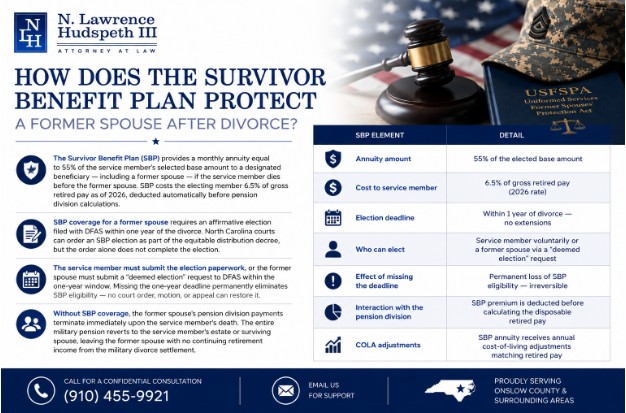
The Survivor Benefit Plan (SBP) provides a monthly annuity equal to 55% of the service member’s selected base amount to a designated beneficiary — including a former spouse — if the service member dies before the former spouse. SBP costs the electing member 6.5% of gross retired pay as of 2026, deducted automatically before pension division calculations.
SBP coverage for a former spouse requires an affirmative election filed with DFAS within one year of the divorce. North Carolina courts can order an SBP election as part of the equitable distribution decree, but the order alone does not complete the election.
The service member must submit the election paperwork, or the former spouse must submit a “deemed election” request to DFAS within the one-year window. Missing the one-year deadline permanently eliminates SBP eligibility — no court order, motion, or appeal can restore it.
Without SBP coverage, the former spouse’s pension division payments terminate immediately upon the service member’s death.
The entire military pension reverts to the service member’s estate or surviving spouse, leaving the former spouse with no continuing retirement income from the military divorce settlement.
| SBP Element | Detail |
| Annuity amount | 55% of the elected base amount |
| Cost to service member | 6.5% of gross retired pay (2026 rate) |
| Election deadline | Within 1 year of divorce — no extensions |
| Who can elect | Service member voluntarily or a former spouse via a “deemed election” request |
| Effect of missing the deadline | Permanent loss of SBP eligibility — irreversible |
| Interaction with the pension division | SBP premium is deducted before calculating the disposable retired pay |
| COLA adjustments | SBP annuity receives annual cost-of-living adjustments matching retired pay |
Drafting and submitting a military pension division order in Onslow County typically costs between $1,500 and $5,000 in attorney fees, based on 2026 Onslow County estimates, depending on the case’s complexity.
Contested pension valuations involving forensic accounting, disputes over the frozen benefit calculation, or VA disability indemnification provisions increase costs toward the higher end of the range.
Court filing fees in Onslow County Superior Court for the equitable distribution claim run approximately $225 as of 2026. The DFAS application process (DD Form 2293) carries no filing fee, but the clerk of court certification required within 90 days adds a nominal certification charge.
Camp Lejeune legal assistance offices at the base provide initial guidance on pension division rights, but they cannot draft MPDOs or represent either spouse in Onslow County Superior Court.
Family financial mediation can resolve pension division disputes before trial, reducing overall costs. Mediated agreements on pension share, SBP election, and VA disability indemnification carry the same enforceability as contested court orders once the Onslow County court approves the consent judgment.
Errors in MPDO drafting — missing High-3 figures, incorrect creditable service calculations, or omitted jurisdictional findings — result in DFAS rejection.
Each rejection requires attorney time to amend, re-certify, and resubmit, adding $500 to $1,500 in additional fees per resubmission cycle based on 2026 Onslow County estimates.
If you’re ready to get started, call us now!
Does the Frozen Benefit Rule Apply to Every Military Divorce in North Carolina?
The frozen benefit rule applies to divorces finalized after December 23, 2016, where the service member had not yet begun receiving retired pay. Divorces granted before that date or after the service member already retired follow the pre-2017 time rule division method.
Can a North Carolina Court Divide a Military Pension if the Marriage Lasted Less Than 10 Years?
North Carolina courts retain authority to divide military retired pay regardless of the length of the marriage. The 10/10 rule restricts only DFAS direct payment processing. Marriages shorter than 10 years of overlap require the service member to pay the former spouse’s share directly.
What Is the High-3 Figure in a Military Pension Division Order?
High-3 represents the average of the service member’s highest 36 consecutive months of basic pay. DFAS requires the actual High-3 dollar amount as of the date of divorce in every post-2016 MPDO. Omitting the High-3 amount causes DFAS to reject the order.
How Does North Carolina’s Equitable Distribution Apply to Military Pensions?
North Carolina divides military retired pay under N.C.G.S. § 50-20 using 12 statutory factors that may justify unequal division. The court calculates the marital fraction, applies an equitable percentage, and enters the result in the MPDO for DFAS submission.
What Happens if DFAS Rejects a Military Pension Division Order?
DFAS returns rejected orders without processing and identifies the deficiency. The attorney must amend the order, obtain a new court signature, recertify with the Onslow County Clerk within 90 days, and resubmit to DFAS using a new DD Form 2293.
Can a Former Spouse Lose SBP Coverage After It Has Been Elected?
SBP coverage remains effective unless the former spouse remarries before age 55, which terminates the annuity under federal regulation. Remarriage after age 55 does not terminate coverage. The former spouse regains eligibility if the subsequent marriage ends by death or divorce.
Does VA Disability Compensation Reduce the Former Spouse’s Pension Share?
VA disability compensation reduces disposable retired pay dollar-for-dollar under 10 U.S.C. § 1408(a)(4), thereby reducing the former spouse’s pension share. CRDP partially restores the disposable retired pay for veterans rated at 50% or higher disability.
What Is the Sullivan Silent Partner Series?
The Silent Partner series consists of practitioner-focused information letters on military pension division, SBP, and related topics, authored by Mark E. Sullivan (COL, USA-Ret.) and published jointly by the NC State Bar LAMP Committee and the ABA Family Law Section Military Committee.
Can a Service Member Be Ordered to Retire So the Former Spouse Receives Pension Payments?
The USFSPA at 10 U.S.C. § 1408 explicitly prohibits state courts from ordering a service member to retire for pension division purposes. North Carolina follows this same federal restriction. The former spouse must wait until the service member voluntarily retires before pension payments begin.
Where Does a Former Spouse Submit the Military Pension Division Order?
The former spouse submits DD Form 2293, a certified MPDO copy, and the divorce judgment to DFAS at P.O. Box 998002, Cleveland, OH 44199-8002. Guard and Reserve orders for Coast Guard members go to the Coast Guard Pay and Personnel Center in Topeka, Kansas.
A military pension represents decades of earned retirement income — protect your share with an attorney who understands USFSPA, the frozen benefit rule, and DFAS compliance. Hudspeth Family Law has served Camp Lejeune military families in Onslow County for over 35 years — call today to protect your retirement.
Office

Links