


North Carolina’s divorce rate has trended downward in line with national declines, driven by later marriage, shifting who marries, cohabitation, and economic/education changes.
Recent CDC and Census data show ongoing drops, with NC mirroring U.S. trends while retaining regional differences. CDC

North Carolina’s crude divorce rate is 3.4 per 1,000 residents, down from about 5.1 per 1,000 in the 1990s–early 2000s, according to CDC/NCHS and NC DHHS reporting, matching the national downward trend.
The decline in divorce rates really shows how people’s attitudes toward marriage and relationships have shifted.
People are getting married later, and there’s more economic pressure that can make divorce feel less doable.
If you live in North Carolina, understanding these patterns might help you make sense of your own relationship decisions—or at least know what to expect legally.
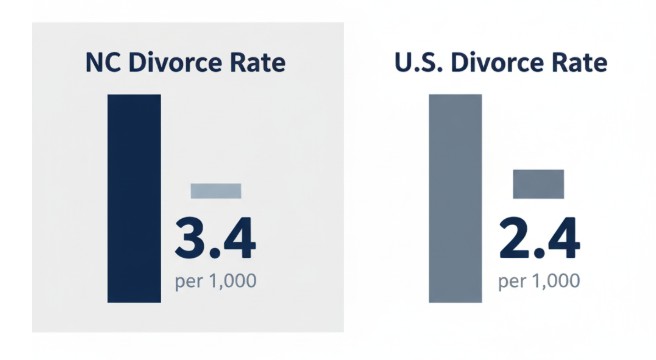
The U.S. crude divorce rate is 2.4 per 1,000 people (CDC 2022 provisional), while North Carolina’s is 3.4 per 1,000 — slightly higher than the national trend.
Data note: Some states do not report divorces every year, and CDC numbers are sometimes provisional, meaning totals may be revised once late filings are processed.
The national divorce rate has dropped hard over the last twenty years. Divorce rates fell from 3.6 per 1,000 people in 2010 to 2.4 per 1,000 in 2022.
That’s a significant change. The 28% decrease between 2012 and 2022 suggests marriages might be holding up better than before.
The CDC tracks these rates based on women aged 15 and older. Marriage rates have remained steady, but divorce rates for this group have dropped significantly.
Better relationship education and shifting attitudes toward divorce help drive this trend.
North Carolina’s divorce rate is still above the national average. The state records 3.4 divorces per 1,000 people, compared with the U.S. rate of 2.4.
But if you look back, North Carolina had 5.1 divorces per 1,000 people in the 1990s. That’s a pretty steep decline over the years.
The state is one of 14 states with divorce rates well above the national trend. Regional differences inside North Carolina play a role, too.
Current NC Statistics:
Divorce stats aren’t as tidy as you’d think. Some states don’t report all their data to federal agencies, so the numbers can be a little fuzzy.
North Carolina’s crude divorce rate, which measures divorces per 1,000 total population, can tell a different story than refined measures that adjust for the married population. County and demographic details really matter here.
The 2023 U.S. rate of 2.4 per 1,000 is based on provisional counts. Final numbers sometimes change after late filings and corrections.
Key Data Issues:
All these things explain why divorce rate statistics can vary between sources and why demographic breakdowns are crucial for getting the real story.
N. Lawrence Hudspeth III helps individuals navigate divorce decisions with clarity and confidence, offering guidance through separation, custody, and support. Take control of your next step. Contact us.
If you’re ready to get started, call us now!
Researchers point to three main reasons for the decline in divorce rates. People are marrying later, and with better education, more couples are living together first. The pandemic pushed rates even lower than before.
Women who wait until later in life to marry are less likely to get divorced. Research shows divorce risks keep dropping for recent marriages, and age is a huge factor.
The average age at first marriage keeps climbing. People have more time to finish school, build careers, and learn what they want in a partner.
Education levels matter a lot:
Studies found that divorce rates dropped for younger women who now wait longer to marry. Only the most committed couples end up getting married these days.
Many couples cohabit before marriage, which acts as a compatibility filter — only those with stronger alignment proceed to marriage.
Cohabitation lets people see if they’re really compatible without the legal mess. If it doesn’t work out, it’s easier to walk away than go through a divorce.
Key screening benefits:
Usually, only couples who make it through cohabitation decide to marry. That means the marriages that do happen are often stronger.
The legal marriage rate is down, but marriage is rarer and more stable now. Couples who marry after living together usually have more realistic expectations.
During the pandemic, divorce filings dipped temporarily due to court slowdowns and financial uncertainty, but even after courts reopened, rates remained below early-2000s levels.
Pandemic impacts:
The divorce rate was 2.4 per 1,000 people in 2022. That’s a big drop from the 1980s peak of 3.6 per 1,000.
Even after the pandemic restrictions ended, divorce rates stayed low. The pandemic just sped up a trend that was already happening.
North Carolina has its own quirks when it comes to divorce. Middle-aged adults and rural counties have higher divorce rates than urban areas, and the stats reveal real differences from the national picture.
Rural counties generally show higher crude divorce rates, while urban areas tend to show more stable marriages, likely due to greater access to counseling, jobs, and educational opportunities.
Middle-aged adults (40-54) get divorced more often than younger couples. This “gray divorce” trend seems to hit North Carolina harder than some other states.
Rural areas face more financial stress. Fewer jobs and lower pay can put a lot of strain on marriages.
In cities, couples have more access to counseling and support. That extra help can make a difference when things get rough.
Urban areas also offer more educational opportunities, which often lead to lower divorce rates. Education helps marriages last.
North Carolina’s divorce patterns align with trends across the Southeast, but the state has its own quirks, too. The CDC’s regional data shows how North Carolina stacks up against its neighbors.
North Carolina’s divorce rate is 2.7-3.4 per 1,000 residents, which puts it in the middle among Southeastern states. Some nearby states have higher rates, while others have lower rates.
Southern states usually have higher divorce rates than the Northeast or the West Coast. Culture and economics both play a role in these differences.
Comparison Points
The state’s mix of growing cities and old-school rural communities shapes its divorce numbers. You can see both regional trends and some local flavor in the data.
If the changing divorce landscape has you reconsidering your own situation, working with N. Lawrence Hudspeth III ensures steady direction and practical legal planning. Schedule an appointment.
If you’re ready to get started, call us now!
Knowing when mediation works better than going to court—and getting your paperwork in order—can save you thousands.
Most divorces cost somewhere between $7,000 and $15,000, but thoughtful planning can keep that bill way lower.
Mediation usually works best when couples agree about big stuff like child custody or property. It runs about $150-$300 per hour, which is a lot less than the $300-$500 per hour you’d pay for court battles.
Mediation is ideal when:
You’ll probably need to go to court if one spouse hides assets or refuses to play fair. High-conflict or abusive situations also call for a judge.
Choose litigation if:
Plenty of couples start with mediation and only head to court if talks break down. That way, you might save money but still have a backup if things get tough.
Most North Carolina divorce lawyers require a $3,000- $7,500 retainer upfront. Hourly rates usually range from $250 to $500, depending on where you are and who you hire.
| Option | Best For | Cost | Key Benefit |
| Mediation | Couples willing to negotiate | $150–$300/hr | Faster, more control, lower cost |
| Litigation | High-conflict or complex cases | $300–$500/hr | The judge decides when the negotiation fails |
Common fee structures:
| Fee Type | Cost Range | Best For |
| Hourly | $250-$500/hour | Complex cases |
| Flat fee | $1,500-$5,000 | Uncontested divorce |
| Limited scope | $500-$2,000 | Document prep only |
Major cost drivers include:
Uncontested divorces usually cost under $3,000 total. Contested ones? Those can average $12,000 to $20,000 per spouse.
Start gathering your financial documents early. That really speeds things up and reduces attorney hours.
Missing paperwork? That just leads to more delays and extra costs—nobody wants that.
Essential financial records:
Property documentation:
Personal information:
Sort your documents by category. Stick them in clearly labeled folders.
Digital copies make it way easier to share with attorneys or mediators. Trust me, they’ll thank you for that.
When divorce becomes the right decision, choose confidence and support every step of the way — rely on N. Lawrence Hudspeth III, Attorney at Law. Contact us.
If you’re ready to get started, call us now!
Why is the divorce rate declining in North Carolina?
Research suggests that North Carolina’s divorce rate is declining because couples are marrying later, cohabiting before marriage, and entering marriage with greater financial and emotional stability.
Is North Carolina’s divorce rate still higher than the national average?
Yes. The U.S. crude divorce rate is 2.4 per 1,000 people, while North Carolina’s rate is about 3.4 per 1,000, making it slightly above the national trend.
Why does North Carolina have a higher divorce rate than some states?
North Carolina has a mix of rural and urban counties, and rural regions typically have higher divorce rates due to lower incomes, fewer social support resources, and greater economic stress on families.
Did divorce rates drop because of COVID-19?
Partly. During the pandemic, divorce filings dipped as courts slowed and financial uncertainty led people to delay legal action. Even after courts reopened, rates stayed lower than pre-pandemic levels.
Are couples less likely to divorce if they live together first?
Cohabitation doesn’t guarantee success, but it acts as a compatibility filter. Couples who live together tend to enter marriage with more realistic expectations and are less likely to divorce.
How does age affect divorce risk in North Carolina?
Divorce risk is higher for couples who marry young. Waiting to marry until your late 20s or early 30s significantly reduces the likelihood of divorce.
What should I do if I’m considering divorce in North Carolina?
Start by gathering financial records, exploring mediation if possible, and speaking with a family law attorney who understands local county court procedures and filing requirements.
Office

Links