

Divorce rates in North Carolina continue to fluctuate as social patterns and laws evolve.
Couples and legal professionals closely monitor these numbers to identify trends and prepare for potential legal issues.
The North Carolina divorce rate has dropped in recent years, mirroring a national move toward fewer divorces per capita.
While Nevada reported the highest divorce rate of any state in 2021, at 4.2 per 1,000 females, North Carolina’s numbers tell a different story about marriage stability in the state.
Examining these statistics helps individuals make more informed decisions about relationships and legal matters.
The data reveals patterns across age groups, locations, and backgrounds that influence how divorce impacts North Carolina communities.
People look up North Carolina’s divorce rate for various reasons—from pure curiosity to planning significant life changes.
Knowing the numbers helps people prepare both legally and emotionally, and it sheds light on broader shifts affecting families.
Many North Carolinians begin searching for divorce statistics when they notice changes among friends or in their own town. Social media chatter about relationships can prompt people to consider local divorce trends.
Personal Planning Reasons:
According to recent research, North Carolina’s divorce rate is 2.7 divorces per 1,000 residents. That gives people a sense of whether their experience matches the norm.
Some people dig into these stats during tough times in their relationship. They just want to know if their struggles are common in the state.
Divorce statistics help people make informed decisions about significant life choices. Lawyers use this info to guide clients on what to expect during a separation.
Financial Planning Benefits:
North Carolina requires couples to live apart for at least a year and a day before they can file for absolute divorce (source). This separation rule shapes how couples plan their next steps.
Mental health professionals also discuss divorce statistics with clients. They remind people that relationship struggles aren’t rare—many families go through similar experiences.
Divorce rates reveal a great deal about changing values and the economy. North Carolina’s divorce rate dropped from 5.1 per 1,000 people in the 1990s to 2.7 today.
Cultural Changes Reflected:
The decline in both marriage and divorce rates shows families are adapting to modern life. These patterns help researchers gain a better understanding of shifting priorities.
Community leaders utilize divorce data to inform the planning of support services. They look at stats to decide where family counseling programs might do the most good in different counties.
Divorce statistics are more than numbers—they reflect real families. If you’re considering divorce in North Carolina, L. Hudspeth Family Law can help you navigate child custody. Contact us today.
If you’re ready to get started, call us now!
![What Is The Current Divorce Rate In North Carolina? [2025 Update]](https://www.lhudspethfamilylaw.com/wp-content/uploads/2025/08/lh6.jpg)
North Carolina’s divorce rate is at 2.7 divorces per 1,000 residents in 2025, which is higher than the national average. This comes from both CDC stats and local law firm reports.
North Carolina’s divorce rate is 2.7divorces per 1,000 residents as of 2025. That’s the most up-to-date number from recent legal data.
The rate has changed a lot. In 2000, the rate was 5.1 per thousand people. It’s been dropping ever since.
Lots of things shape these numbers. The pandemic shut down courts for a while. Job losses also had an impact, affecting both marriage and divorce rates.
Divorce rates use a pretty straightforward system. The rate indicates the number of divorces that occur for every 1,000 people living in the state.
Here’s the basic formula:
This way, you can compare states fairly, even if they differ in size. North Carolina’s numbers line up with this method.
The calculation covers all residents, not just married folks. That’s the usual way government agencies track divorce statistics in the U.S.
North Carolina’s 2.7 rate beats the national average. The U.S. crude divorce rate is 2.4, according to the latest data.
State Comparison:
North Carolina’s rate is higher than those of South Dakota (2.4), Texas (1.4), and Georgia (2.2). So, North Carolina sits in the upper range for state divorce rates.
But a higher rate doesn’t always mean more relationship trouble. State laws and procedures can skew these numbers.
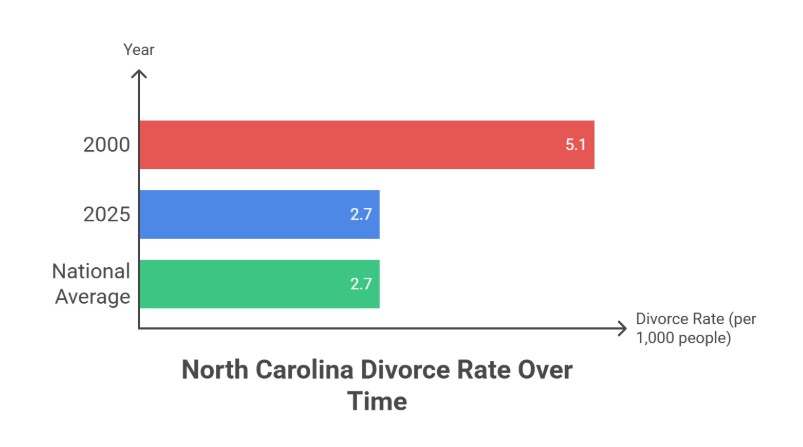
North Carolina’s divorce rate has dropped sharply over the last twenty years. The divorce rate has decreased from 5.1 per 1,000 people in 2000 to about 2.7 per 1,000 now.
This steady decline reflects factors such as people waiting longer to get married and increased financial stability for couples.
In 2000, North Carolina’s divorce rate was 5.1 per thousand people. Since then, it’s fallen to 2.7 per 1,000 residents, which is still above the U.S. average of 2.7 per 1,000.
The pandemic years accelerated this decline. Marriage and divorce rates both declined during the COVID-19 pandemic, as courts closed and unemployment increased.
Key Historical Changes:
That’s almost a 40% drop in 25 years. Census data backs up the steady decline in North Carolina and in most other states.
Several big factors drive North Carolina’s falling divorce rates. Delayed marriage is significant—people who marry later tend to have greater maturity and stability.
Better economic conditions help, too. Couples with steady jobs and higher incomes face less financial stress, which means fewer fights. The state’s job growth in tech and healthcare has opened up opportunities.
Education matters as well. Individuals with college degrees tend to have lower divorce rates due to better communication and more stable careers. North Carolina’s growing university system has raised education levels across the state.
Other factors include:
All these factors help explain why North Carolina’s divorce rate continues to decline, even though it remains above the national average.
Seeing shifts in North Carolina’s divorce rate? It might be time to reevaluate your own situation. L. Hudspeth Family Law supports clients with equitable distribution cases. Schedule your consultation now.
If you’re ready to get started, call us now!
North Carolina ranks 18th in the country for divorce rates. With 2.7 divorces per 1,000 people, the state sits above the national average and falls into the higher-than-average category, according to several national data sources.
North Carolina ranks 18th in the nation for divorce rates, placing it in the middle of all 50 states. Although it doesn’t rank at the top, the state still sees more divorces than many others.
This ranking aligns with broader regional trends. Southern states exhibit considerable variation, and some have significantly higher divorce rates than North Carolina.
Key ranking factors include:
Landing at 18th, North Carolina maintains a relatively stable marriage dissolution rate. It’s not extreme compared to states at the top or bottom of the list.
North Carolina’s divorce rate of 2.7 per 1,000 people beats the national average of 2.3 per 1,000. So, it’s among the states with above-average divorce rates.
Maryland, Virginia, and Washington also sit at 2.7. Some North Carolina counties have even higher rates, which makes things uneven across the state.
States like Arkansas, New Mexico, Wyoming, Kentucky, and West Virginia top the charts. North Carolina still has higher divorce rates than about 32 other states, though.
WorldPopulationReview lists North Carolina at 2.7 divorces per 1,000 people for 2025. It’s a handy source for side-by-side state comparisons.
CDC data support North Carolina’s 2.7 divorces per 1,000 population rate. The CDC tracks marriage and divorce as part of its vital statistics.
Both sources employ the same approach: divorces per 1,000 of the total population. That keeps things consistent for comparing states.
Divorce patterns in North Carolina differ by age and location. Grey divorce rates have more than doubled since 1990 for folks over 50, and rates swing a lot across counties.
Men and women don’t experience divorce the same way in North Carolina. Women file for divorce more—about 70% of the time.
Gender differences stand out. Women usually leave due to emotional needs not being met, while men point to financial stress or communication issues.
Educational backgrounds matter too. College-educated couples split less often than those without degrees, and this holds true in both urban and rural areas.
Income levels play a big role. Couples making under $50,000 a year are more likely to split up than those earning above $75,000.
Age at marriage really predicts divorce risk in North Carolina. Couples marrying before 25 almost double their odds of divorce compared to those who wait until after 30.
Divorce rates for people 50 and older have more than doubled since 1990. The “grey divorce” trend continues to grow.
Young couples (ages 20-35) face challenges such as shaky finances and career changes. That stress definitely pushes up divorce rates for them.
Older couples (50 and above) often split after their children leave home. For people 65 and up, divorce rates have tripled since 1990, hitting six per thousand married folks.
Empty nest syndrome and shifting goals push many later-in-life divorces. These couples typically have more assets to divide, making the process more complicated.
Divorce rates bounce around a lot depending on where you are in North Carolina. Cities like Charlotte and Raleigh look different from rural counties.
Urban counties usually have:
Rural counties tend to show:
Charlotte and Wake County (Raleigh) see the most divorce filings. That’s partly due to population growth, but urban living also plays a role.
Mountain and coastal rural counties often report fewer divorces. Tight-knit communities and traditional values help explain that.
The average age for a first divorce in North Carolina is 32 for women and 34 for men. People are marrying later, so divorces tend to occur later as well.
First-time divorce trends show folks wait longer before calling it quits. On average, marriage lasts about eight years before divorce here.
Age-related factors include:
Couples divorcing in their early 30s usually say they’ve grown apart. They married young and underwent significant changes in their twenties.
Second and third divorces pop up later, with averages in the early 40s for those marriages.
Divorce statistics shape how people should approach legal and financial planning in North Carolina.
Current divorce trends offer valuable insights for informed decisions about marriage, finances, and protecting your family.
Divorce trends let you gear up for legal challenges before they hit. If you know that North Carolina has a divorce rate of 2.7 per 1,000 residents, you can make more informed choices about legal protection.
When you spot these trends, you know when to reach out to a divorce attorney or family law pro. Planning early usually means better results and lower costs.
Key legal preparedness areas include:
Some couples use trend data to catch warning signs in their own marriages. That way, they can try counseling or mediation before the situation escalates.
Divorce lawyers often say that clients who are familiar with the statistics come in better prepared. They ask sharper questions and make choices based on reality, not just emotion.
Divorce rate data helps you plan for possible costs and outcomes. North Carolina uses equitable distribution, which means marital property gets divided fairly—but not always equally.
Financial considerations based on divorce trends:
| Area | Planning Strategy |
| Child Support | Budget for possible payments using state guidelines |
| Alimony | Learn about how long and how much spousal support might be |
| Legal Costs | Set aside funds for attorney fees |
| Property Division | Keep good records of assets and debts |
Child custody in North Carolina typically favors shared parenting when feasible. Parents who are aware of this can focus on maintaining strong bonds with their children, even during tough times.
Equitable distribution covers retirement accounts, real estate, and business interests. Couples who plan ahead tend to protect more of what they’ve built.
Spousal support depends on factors such as marriage length, income gaps, and other relevant considerations. Knowing these patterns helps individuals make more informed career and financial decisions during marriage.
“When clients understand divorce statistics and trends, they make more rational decisions about their legal strategy. They’re less likely to chase unrealistic outcomes and more focused on protecting their kids and their financial future. This knowledge helps them work better with their divorce lawyer and often leads to more successful settlements through mediation instead of expensive court battles.”
Family law professionals often say that informed clients handle divorce with less stress. They know what to expect from child custody evaluations and property appraisals.
They also gain a clearer understanding of support calculations. That kind of preparation can make a real difference.
Mediators see higher success rates when both parties understand typical divorce outcomes in North Carolina. People set more realistic expectations about timelines and costs.
They also tend to accept final agreements more easily. It just smooths things out.
Some divorce attorneys even suggest couples review divorce trends and legal basics while their marriages are solid. Taking that step can help them make smarter decisions about finances and insurance.
When divorce becomes your reality, you don’t have to go it alone. L. Hudspeth Family Law provides compassionate representation in alimony and spousal support matters. Contact us to get started.
If you’re ready to get started, call us now!
What is the current divorce rate in North Carolina?
According to the most recent CDC data, North Carolina’s divorce rate is 2.7 divorces per 1,000 residents, which closely aligns with the national average.
Has the divorce rate in North Carolina gone up or down?
North Carolina’s divorce rate has decreased steadily over the past two decades, dropping from around 5.1 per 1,000 residents in the early 2000s to 2.7 today.
How does North Carolina compare to other states in divorce rates?
North Carolina ranks near the middle nationally, with a divorce rate of 2.7 per 1,000—lower than states like Nevada and Arkansas but higher than states like New York and California.
What factors influence divorce rates in North Carolina?
Common influences include age at marriage, financial stress, education level, and whether the couple has children. Rural areas have slightly higher rates than urban counties.
Are certain counties in North Carolina more prone to divorce?
Yes, rural counties such as Robeson, Halifax, and Rutherford often report higher divorce rates than urban centers like Wake or Mecklenburg County.
What age group has the highest divorce rate in North Carolina?
People between the ages of 40 and 54 tend to have the highest divorce rates in North Carolina, especially in second or later marriages.
Why is tracking the divorce rate important for North Carolina residents?
Understanding divorce trends helps individuals plan more effectively for legal, financial, and emotional outcomes, and enables attorneys and mediators to anticipate client needs and service gaps.
Office

Links