


North Carolina courts route separating parents into mediation before a custody hearing, and a mediated divorce keeps parenting decisions with the two people who know the children best.
Under N.C. Gen. Stat. § 50-13.1, contested custody and visitation matters are set for mediation unless a judge waives it for good cause.
A separate program under § 7A-38.4A handles equitable distribution, alimony, and support. Families who mediate report falling coparenting conflict in the year after settlement, while litigating families report it rising.
Facing a custody schedule you did not choose is the outcome mediation prevents. N. Lawrence “Larry” Hudspeth III mediates and litigates family matters in Jacksonville — request a consultation.
A mediated divorce in North Carolina is a divorce in which the spouses negotiate custody, property, and support terms with a neutral mediator instead of asking a district court judge to impose them.
The mediator decides nothing. The mediator structures the conversation, isolates the disputed issues, and drafts the terms the parties agree to.
North Carolina layers mediation onto the existing statutory framework rather than replacing it.
Spouses still satisfy the separation requirement in N.C. Gen. Stat. § 50-6, which grants an absolute divorce only after one year of living separate and apart, with six months of state residency.
Mediation resolves what happens to the children and the marital estate during and after that year, so families settle the substantive questions while the statutory clock runs.
N. Lawrence “Larry” Hudspeth III, a North Carolina State Bar Board-Certified Family Law Specialist and certified mediator in Jacksonville, North Carolina, works both sides of that process — mediating child custody and financial disputes and litigating them when negotiation fails.
If you’re ready to get started, call us now!
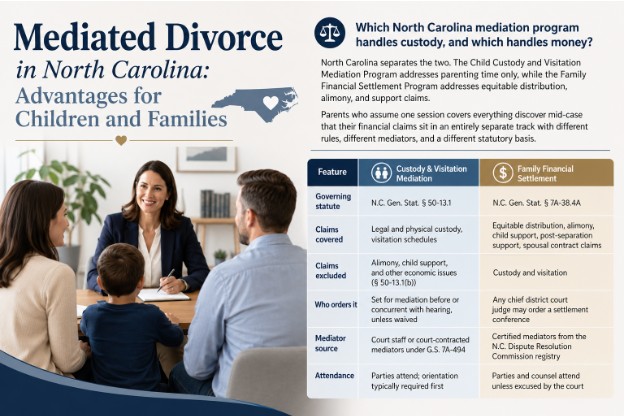
North Carolina separates the two. The Child Custody and Visitation Mediation Program addresses parenting time only, while the Family Financial Settlement Program addresses equitable distribution, alimony, and support claims.
Parents who assume one session covers everything discover mid-case that their financial claims sit in an entirely separate track with different rules, different mediators, and a different statutory basis.
| Feature | Custody & Visitation Mediation | Family Financial Settlement |
| Governing statute | N.C. Gen. Stat. § 50-13.1 | N.C. Gen. Stat. § 7A-38.4A |
| Claims covered | Legal and physical custody, visitation schedules | Equitable distribution, alimony, child support, post-separation support, spousal contract claims |
| Claims excluded | Alimony, child support, and other economic issues (§ 50-13.1(b)) | Custody and visitation |
| Who orders it | Set for mediation before or concurrent with hearing, unless waived | Any chief district court judge may order a settlement conference |
| Mediator source | Court staff or court-contracted mediators under G.S. 7A-494 | Certified mediators from the N.C. Dispute Resolution Commission registry |
| Attendance | Parties attend; orientation typically required first | Parties and counsel attend unless excused by the court |
The North Carolina Judicial Branch explains that once a settlement procedure is ordered under § 7A-38.4A, the parties and their attorneys must attend unless the court excuses them.
Parties who have experienced domestic violence may be excused from physically attending or participating.
The Rules for Settlement Procedures in District Court Family Financial Cases, first adopted by the North Carolina Supreme Court in 1998, became mandatory across all judicial districts effective March 1, 2007.
Mediation protects children by lowering the sustained parental conflict that drives poor adjustment outcomes, not by shortening the divorce itself. Conflict between parents — not the legal fact of divorce — carries the strongest measured association with children’s later difficulties.
The longitudinal evidence is specific. In the University of Virginia randomized study of families assigned to mediate or litigate custody, parents who mediated reported a decrease in coparenting conflict in the year following settlement, while parents who litigated reported an increase in conflict.
That matters practically in Onslow County. A parenting schedule the parents wrote themselves survives the first schedule change, the first military deployment, and the first school-year adjustment far better than one imposed after contested custody hearing testimony, because both parents already own the terms.
Yes, with defined statutory limits. N.C. Gen. Stat. § 7A-38.4A(j) bars the use of statements and conduct occurring in anticipation of, during, or as follow-up to a family financial settlement conference in any civil proceeding, including proceedings to enforce or rescind a settlement.
The statute carves out narrow exceptions. Testimony attesting that an agreement was signed remains permitted.
So do sanctions proceedings under the section, disciplinary hearings before the North Carolina State Bar or the Dispute Resolution Commission, abuse and neglect proceedings under Chapter 7B, and adult abuse or exploitation proceedings under Chapter 108A.
Confidentiality also does not immunize criminal conduct or excuse mandatory reporting obligations.
In practice, this protection allows a spouse to float a settlement number without that number becoming an admission at trial — the same structural advantage that makes civil mediation effective in commercial disputes.
Your first offer should not become the ceiling for every later negotiation. Larry Hudspeth mediates and litigates Onslow County family matters — schedule a confidential consultation at (910) 455-9921.
If you’re ready to get started, call us now!
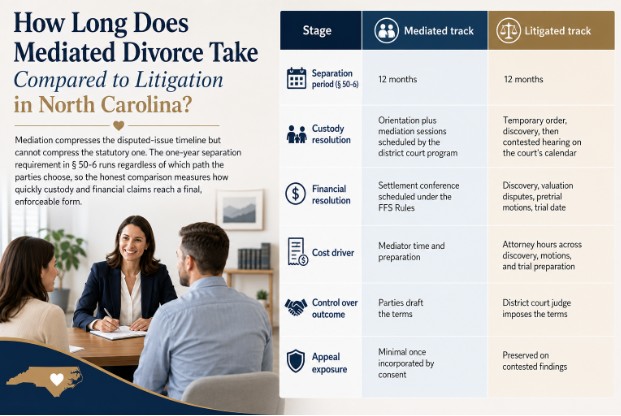
Mediation compresses the disputed-issue timeline but cannot compress the statutory one. The one-year separation requirement in § 50-6 runs regardless of which path the parties choose, so the honest comparison measures how quickly custody and financial claims reach a final, enforceable form.
| Stage | Mediated track | Litigated track |
| Separation period (§ 50-6) | 12 months | 12 months |
| Custody resolution | Orientation plus mediation sessions scheduled by the district court program | Temporary order, discovery, then contested hearing on the court’s calendar |
| Financial resolution | Settlement conference scheduled under the FFS Rules | Discovery, valuation disputes, pretrial motions, trial date |
| Cost driver | Mediator time and preparation | Attorney hours across discovery, motions, and trial preparation |
| Control over outcome | Parties draft the terms | District court judge imposes the terms |
| Appeal exposure | Minimal once incorporated by consent | Preserved on contested findings |
Parties who arrive prepared further shorten the process. Working through the family mediation steps in advance — asset inventories, proposed schedules, childcare costs — converts a session that would have been spent gathering information into one spent negotiating.
Sustained communication between separating spouses determines how many sessions the process actually requires.
N.C. Gen. Stat. § 50-13.1(c) permits a district court judge to waive mediation for good cause, on either party’s motion or the court’s own motion. The statute lists non-exclusive grounds:
Waiver is not automatic. A party seeking it files a motion with supporting facts, and the court rules on the showing.
The North Carolina Judicial Branch confirms that absent a waiver, all cases involving contested custody and visitation of minor children are sent to the program before or concurrent with the setting of a hearing.
Families pursuing post-separation support claims alongside custody should expect two separate tracks even when one is waived.
Only after the court incorporates it. Section 50-13.1(g) requires any agreement reached in custody mediation to be reduced to writing, signed by each party, and submitted to the court as soon as practicable.
Unless the court finds good reason not to, it incorporates the agreement into an order, thereby making it enforceable as a court order.
That distinction decides whether a violated schedule is a broken promise or contempt. An unincorporated parenting memorandum leaves a parent with a contract claim; an incorporated one opens the enforcement remedies available for court orders. The same principle governs financial terms — a settlement covering equitable distribution and child support obligations needs to be entered as a consent order to be enforced as one.
When mediation ends without full agreement, the mediator reports the impasse and the unresolved claims move toward a hearing. Issues that did settle stay settled, which narrows what the judge decides.
Broader context on family law mediation across North Carolina and on divorce rights in Onslow County covers how these tracks interact locally.
If you’re ready to get started, call us now!
Is divorce mediation mandatory in North Carolina?
North Carolina requires mediation for contested custody and visitation under G.S. 50-13.1, and district court judges may order mediated settlement conferences for financial claims under G.S. 7A-38.4A. Absolute divorce itself does not require mediation. Most districts require a group orientation session first.
How much does divorce mediation cost in North Carolina?
Mediator fees for family financial settlement conferences follow the Rules adopted by the North Carolina Supreme Court, and the court order governs how parties divide them. Custody and visitation mediation is handled through the district court’s own program rather than by a privately retained mediator.
Can a North Carolina judge waive custody mediation?
Yes. Under G.S. 50-13.1(c), a district court judge may waive custody mediation for good cause. Recognized grounds include undue hardship, allegations of child abuse or neglect, alcoholism, drug abuse, domestic violence between the parents, or severe psychological problems. Waiver requires a motion.
Does mediation replace the one-year separation requirement for divorce in North Carolina?
No. G.S. 50-6 requires spouses to live separate and apart for one year before either party may obtain an absolute divorce, and one spouse must have resided in North Carolina for six months. Mediation resolves custody and financial claims, not the separation clock.
Are children present during North Carolina custody mediation?
Children rarely attend custody mediation sessions in North Carolina. Parents negotiate the parenting schedule themselves with a court mediator guiding the conversation. Keeping children out of the room prevents them from feeling responsible for choosing between parents while their arrangements are decided.
What happens if North Carolina mediation ends in impasse?
The mediator reports the impasse to the court, and unresolved custody or financial issues proceed toward a hearing. Partial agreements still count. Issues settled in mediation narrow the matters a district court judge must decide, shortening hearing time and reducing preparation expense.
Can a mediated custody agreement be changed later in North Carolina?
Yes. Once incorporated into a court order under G.S. 50-13.1(g), a mediated custody agreement may be modified upon a party’s showing of a substantial change in circumstances affecting the child’s welfare. Modification motions themselves return to mediation unless the court waives it.
Do both spouses need attorneys for family financial mediation in North Carolina?
Parties may attend family financial settlement conferences without attorneys, though the North Carolina Judicial Branch cautions that mediators cannot provide legal advice to any participants. Equitable distribution and alimony claims involve valuation and tax consequences that unrepresented parties frequently misjudge during a single session.
Is what I say in North Carolina mediation admissible in court?
No. G.S. 7A-38.4A(j) makes statements and conduct in a family financial settlement conference inadmissible in civil proceedings. Narrow exceptions exist for attesting that an agreement was signed, sanctions motions, disciplinary hearings, and juvenile or adult abuse proceedings under Chapters 7B and 108A.
Does mediation work when one parent refuses to cooperate?
Court-ordered mediation still produces value with a reluctant participant. Attendance is mandatory unless excused, and structured sessions often surface agreement on discrete issues like holiday schedules or exchange locations. Persistent refusal to negotiate in good faith can support sanctions motions under North Carolina law.
Who certifies divorce mediators in North Carolina?
The North Carolina Dispute Resolution Commission certifies mediators who conduct family financial settlement conferences and maintains the registry district courts draw from. Custody and visitation mediation uses court staff mediators or court-contracted mediators operating under the statewide program established by G.S. 7A-494.
Your children will live with the parenting schedule for years. Larry Hudspeth, a board-certified family law specialist in Jacksonville, mediates and litigates these cases — protect your family’s future at (910) 455-9921.
Office

Links